Quick Answer
Richardson hardwood floors fall into two camps: solid oak in mid-century ranches from the 1950s–70s and engineered wood in newer infill builds and renovations. Solid wood survives humidity swings better but shows wear faster. Engineered wood cleans more easily but can’t be sanded down repeatedly. Both need pH-neutral cleaning, controlled humidity (35–55%), and a professional deep clean every 12–18 months. Ultra Clean does Revitalizing Clean, wax-and-buildup strip, and Revitalization (a urethane top-coat) — not screen-and-recoat and not sand-and-refinish.
By Ultra Clean
IICRC-certified · Family-owned · Serving Richardson since 2013
Walk into a 1964 home in Heights Park and you’ll likely find three-quarter-inch solid red oak running through the foyer and dining room — possibly with a 1990s sun-faded patch where a rug used to sit. Walk into a 2021 infill build off Belt Line Road and you’ll see seven-inch wide-plank engineered oak across the entire main floor.
Same city. Same climate. Two completely different floors that need to be cared for in completely different ways. Get them mixed up — use the wrong cleaner, ignore the wrong warning sign — and you’re looking at warping, cupping, or finish failure that costs thousands to fix.
The Two Richardson Wood Floor Archetypes
Most calls we take in Richardson fit neatly into one of these two buckets. Knowing which one you have is the first step to protecting it.
Archetype 1: Solid Hardwood in Mid-Century Homes
These are the floors in Heights Park, Reservation, Richardson Heights, parts of Cottonwood Heights, and the older sections of Canyon Creek. They were installed when the homes were built — typically 3/4-inch solid red oak or white oak, 2-1/4-inch strip width, nailed down to a plywood subfloor over a slab.
These floors were sanded and finished on site after installation. Most have been refinished at least once in their lifetime — usually with a polyurethane that’s now somewhere between 10 and 30 years old. Many have been covered by carpet at some point and re-exposed during a later renovation, leaving them with patchy wear and tan-line shadows under where furniture sat for decades.
Strengths: They can be sanded and refinished multiple times over their lifetime. With proper care, a solid oak floor installed in 1968 can easily last another 50 years.
Vulnerabilities: They were installed before modern moisture barriers became standard. They expand and contract more visibly with humidity changes. Pet stains and water damage from past plumbing issues are often baked in. And in Richardson specifically, where homes have been added onto over the decades, you’ll often find a transition strip between the original 1960s solid oak in the dining room and a 1995 engineered floor in the family room addition — each needs different care.
Archetype 2: Engineered Hardwood in Newer Infill and Renovations
The newer infill builds tucked between mid-century homes, the larger custom new builds in Country Club Estates, and most full renovations done in Heights Park or Reservation over the last 10–15 years. These homes typically have engineered hardwood — a real wood veneer (usually 2–4mm thick) glued to a plywood or HDF core.
Most are factory-finished with aluminum oxide coatings that are much harder than site-applied polyurethane. They’re also installed as floating floors or with glue-down adhesives, not nailed.
Strengths: More dimensionally stable in humidity swings. Tougher factory finish resists scratches and UV fading. Easier to clean because the surface is sealed tighter.
Vulnerabilities: The veneer layer is the only sandable material. Once that’s gone, the floor is done. Most engineered floors can only be refinished once, sometimes twice if the veneer is thick enough. Cheaper engineered products (under $4/sq ft installed) can’t be refinished at all.
How Richardson’s Humidity Swings Damage Each Type
DFW sits in a climate band where indoor relative humidity can vary from under 25% in January (when the heater runs constantly) to over 60% in July and August (when air conditioning can’t pull it all out fast enough). That 35-point swing is the single biggest stressor on any wood floor.
Wood is hygroscopic — it absorbs moisture from the air when humidity is high and releases it when humidity is low. Boards expand and shrink with that exchange. The faster the swing, the more visible the damage.
What Humidity Damage Looks Like on Solid Hardwood
Winter (low humidity): Gaps appear between boards. You can see down into the seams. Cracks may develop running along the grain.
Summer (high humidity): Boards push against each other and start to cup — edges raise higher than the centers. In extreme cases, you’ll see crowning, where centers rise above the edges, or even buckling at doorways.
In older Richardson homes with original solid hardwood, we frequently see decades of accumulated cupping in kitchens and bathrooms where humidity stayed consistently high near plumbing fixtures.
What Humidity Damage Looks Like on Engineered Wood
Engineered floors handle the swings better thanks to their cross-grain ply core, but they’re not immune. The damage pattern is different.
Low humidity: Micro-gaps at the board edges where the click-lock joints separate slightly. Often hard to see until dust collects in them.
High humidity: Edge swelling — the corners of individual boards puff up slightly. This wears through the factory finish at high-traffic spots much faster than the rest of the floor.
Long-term: Adhesive failure on glue-down installations. Boards start to creak or feel hollow underfoot.
The fix for both archetypes starts with a whole-house humidifier in winter and reliable AC dehumidification in summer. Aim for 35–55% indoor RH year-round. Most Richardson HVAC systems can hit that range with the right add-ons.
Signs Your Floor Needs Attention Now
The earlier you catch wood floor problems, the cheaper the fix. Here’s what to look for, by floor type.
Solid Hardwood Warning Signs
- Dull, hazy finish that doesn’t shine even after cleaning
- Sticky residue underfoot — usually from old cleaning product buildup
- White or gray patches where the finish has worn through to bare wood
- Black stains along board edges (water damage)
- Visible scratches that catch a fingernail (vs. ones you can only see in raking light)
- Gaps wider than a dime between most boards in winter
Engineered Hardwood Warning Signs
- Wear patterns at the entryway, in front of the kitchen sink, or under desk chair wheels
- Edges of individual boards looking lighter than centers
- Cloudy spots that don’t wipe away
- Boards that flex or creak when stepped on
- Visible separation between planks at corners
If you’re seeing any of the above, professional wood floor cleaning is usually the next step. It can buy you years before sanding-and-refinishing becomes necessary — and on engineered floors, it may be the only restoration option you have without replacing boards.
Our Three-Step Decision Path for Richardson Hardwood
This is where Richardson homeowners spend the most money in the wrong direction. Let’s walk through the actual decision tree we use on every in-home assessment. Note: we don’t screen-and-recoat and we don’t sand-and-refinish. If your floor genuinely needs to be sanded to bare wood, we’ll tell you that honestly and recommend a refinisher. What we do — and do well — is everything that comes before refinishing, which keeps most floors looking great for years longer than homeowners expect.
Path A: Revitalizing Clean (Every 12–18 Months)
A professional deep clean removes embedded grime, old cleaning residue, and surface contaminants without touching the finish itself. We use a wood-safe cleaning solution and a low-moisture extraction process — no flooding, no standing water. Important in Richardson: our 14–16 grain-per-gallon hard water leaves visible mineral spotting on hardwood when mop water sits, so we use softened or filtered water and quick recovery.
On solid hardwood with a sound polyurethane finish, this restores 80–90% of the original look. On engineered hardwood with a factory finish, often closer to 95%.
Cost: typically $0.60–$1.20 per sq ft. Lasts 12–18 months with normal maintenance.
Path B: Wax Strip + Natural Polish
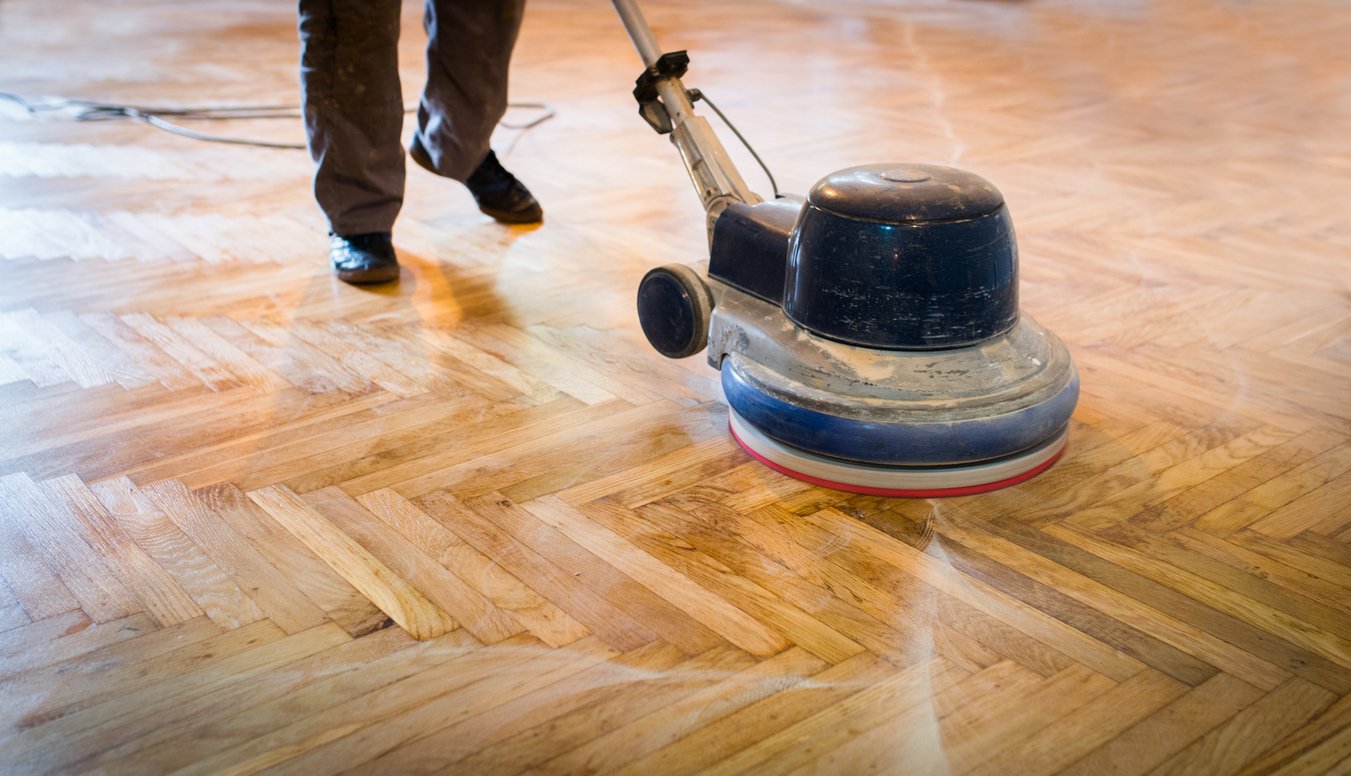
If your floor has had years of acrylic polish or wax buildup (Murphy’s Oil Soap, Bona Refresher, Quick Shine, anything from the supermarket wood-care aisle), revitalizing cleaning alone won’t get through it. The buildup needs to be stripped off first, then the wood gets a natural polish with a soft polishing pad — no chemicals added on top, just a controlled mechanical polish that brings the natural sheen back.
This is the right path when your floor looks dull or cloudy even after cleaning, but the actual finish underneath is still sound. It’s a common situation in mid-century Richardson homes where the floors were never deep-cleaned professionally — just touched up with grocery-store products for ten or fifteen years.
Cost (wax/finish strip): typically $0.95–$1.50 per sq ft. This is in addition to the cleaning if both are needed.
Path C: Revitalization (Urethane Top-Coat Over Existing Polyurethane)
We call this service Revitalization. When the underlying finish is still intact but has lost its shine, we apply a urethane coating over the existing polyurethane that gives the floor a renewed gloss and adds a fresh protective layer — without sanding, staining, or the dust and disruption of a full refinish.
This is not a screen-and-recoat (which abrades the existing finish first) and it’s not a refinish (which removes the existing finish entirely). Revitalization is a top-coat that bonds to the cleaned, stripped, and prepped existing finish. The result: a noticeably shinier floor that buys you 3–7 more years before any sanding-and-refinishing might be needed.
Cost (Revitalization / urethane top-coat): typically $0.75–$1.25 per sq ft.
What If My Floor Actually Needs Sanding and Refinishing?
We’ll tell you straight at the estimate. We don’t sell you a clean-and-polish service that won’t deliver the result you want. If sanding is the right answer, we’ll point you to a reputable refinisher in DFW — and after they’re done, you come back to us for the next 12–18-month maintenance cycle.
Not sure which path your floor needs?
We offer free in-home assessments across Richardson — Heights Park, Reservation, Canyon Creek, Cottonwood Heights, Sherrill Park. We’ll tell you honestly — including when the right answer is “keep doing what you’re doing for another year” or “this needs a sanding-and-refinish specialist, not us.”
Call (469) 535-9331 or book at ultracleanfloorcare.com/richardson.
What Professionals Do Differently Than Store-Bought Products
The hardwood floor aisle at any big-box store offers a dozen “restorer” and “polish” products. Most of them cause more damage than they prevent. Here’s why.
Acrylic-based polishes leave a film on the surface that traps dirt. Over time it builds up into a cloudy, uneven layer that no normal cleaning removes. The only fix is a chemical strip — which itself can damage the finish underneath. We’re called to strip polish buildup from Richardson floors at least once a month.
Murphy’s Oil Soap and similar oil-based cleaners are sold for wood, but they leave residue that prevents future refinishing products from bonding. If you’ve used it for years, your floor may need professional stripping before any refinishing can happen.
Steam mops are the single most damaging tool we see in wood-floor homes. Steam forces moisture through the finish into the wood. On engineered floors it can delaminate the veneer. On solid wood it causes long-term swelling and finish failure. Don’t use one on wood, period.
What we use instead: a pH-neutral, residue-free wood cleaner combined with low-moisture mechanical extraction. The cleaner dissolves embedded soil. The extraction lifts it away without water ever sitting on the floor. We finish with a wood conditioner that protects the existing finish — no film, no buildup.
Protecting Wood Near Entryways and Kitchens
Two areas wear out faster than the rest of any wood floor: the entry from the garage and the strip in front of the kitchen sink. These zones get 80% of the moisture and 60% of the abrasion in a typical Richardson home.
At the garage entry: A two-mat system. A coarse outdoor mat for the rough soil, a second indoor mat for the fine grit and moisture. Replace both annually. The outdoor mat especially picks up the limestone dust common to North Texas job sites and lawn services that’s brutally abrasive to wood finish.
In front of the kitchen sink: A washable, low-profile rug with a non-rubber backing. Rubber-backed mats trap moisture against the finish and cause discoloration over time. Cotton or polyester backing breathes.
Furniture: Felt pads on every chair and table leg. Replace them every 6 months — they wear down faster than you’d think and grit gets embedded in them, turning them into sandpaper.
Pet bowls: A waterproof tray under every food and water station. Splash damage adds up.
For Richardson homes with kids and pets, this routine is the difference between needing a full sand-and-refinish every 8 years and stretching that to 20+.
Your Year-Round Maintenance Routine
A simple schedule that protects both solid and engineered floors:
Daily: Sweep or dust-mop high-traffic areas. Microfiber works best — it lifts grit instead of pushing it around.
Weekly: Damp-mop with a pH-neutral wood floor cleaner. Use a barely-damp microfiber pad, never a sopping mop. Spot-clean spills immediately, especially water near the kitchen and bathroom transitions.
Monthly: Check the humidity in the main living areas. Keep it between 35–55%. Move rugs and mats slightly to prevent permanent shadowing under them.
Quarterly: Inspect entryways, the kitchen sink area, and pet zones for early wear. Refresh furniture pads.
Annually: Professional hardwood deep clean — or every 12–18 months minimum. This is the highest-value maintenance investment for a wood floor over its lifetime. Tech-professional households along the Telecom Corridor often set this on an auto-schedule with the rest of their floor and upholstery maintenance.
Many of our Richardson clients have tile and stone elsewhere on the property too. If that’s you, our broader floor cleaning and restoration services handle every surface in one visit.
FAQ
How can I tell if my Richardson home has solid or engineered hardwood?
Look at an exposed edge — at a vent register, a transition, or a staircase. Solid wood shows continuous grain top to bottom. Engineered shows visible layers, like plywood, with a thin wood veneer on top. Most Richardson mid-century homes (1950s–70s) have solid; most homes built after 2010 and most full renovations done in the last decade have engineered.
How often should I deep-clean my hardwood floors in Richardson?
Every 12–18 months for professional cleaning. With kids, pets, or heavy entertaining, lean toward 12. The cost is minimal compared to sanding-and-refinishing, and it dramatically extends the time before sanding is ever needed.
Is my engineered hardwood floor ruined if humidity has caused edge swelling?
Not necessarily. Mild edge swelling can be improved by stabilizing humidity in the 35–55% range and giving the wood time to acclimate. Severe swelling that’s cracked the finish usually means localized board replacement — not a full refinish.
Can engineered hardwood be refinished?
Sometimes — worth knowing even though we don’t refinish ourselves. It depends on the veneer thickness. Engineered floors with 3mm+ veneer can be sanded and refinished once, occasionally twice, by a refinishing specialist. Cheaper products with 1mm or less veneer cannot. Check your manufacturer’s documentation if you have it.
What’s the cheapest way to make old hardwood floors look better in Richardson?
A professional revitalizing clean, plus a wax-and-buildup strip if needed, plus Revitalization (a urethane top-coat over the existing finish). Together these typically cost a fraction of sanding-and-refinishing and buy you 3–7 more years before sanding is ever needed. This is our most common recommendation in older mid-century Richardson homes.
Will my floors warp from Richardson humidity if I leave town for a week?
Probably not from a week. Boards adjust slowly. Risk increases with longer absences, especially in summer with AC off or set high. If you travel for weeks, leave the AC set at 78°F and run a portable dehumidifier in main living areas.
Do I need to refinish before selling my Richardson home?
Usually no. A deep clean, wax strip, and Revitalization (urethane top-coat) is enough to impress buyers without the cost and disruption of a full sand-and-refinish. Listing agents in Richardson typically agree — clean, glossy floors look new in photos, and the buyer can decide whether to sand-and-refinish to their own taste later.
Related services: If you also need hardwood floor cleaning in McKinney or tile and grout cleaning in Richardson, we run those routes the same week. And outside, we also offer power washing in Richardson. And up the road, hardwood floor cleaning in Forney TX.
Ready to Protect Your Hardwood?
Wood floors that hold their value for decades, not just years.
Call (469) 535-9331 or visit ultracleanfloorcare.com/richardson for a free in-home assessment.
For homeowner guidance on wood-floor care, the National Wood Flooring Association is the industry’s authoritative resource.