Quick Answer
Grout turns dark in Richardson homes because porous cement absorbs hard-water minerals, soap residue, and ground-in soil faster than mopping can remove it. Mid-century homes from the 1950s–70s often have original grout that’s never been professionally cleaned. If the discoloration is surface staining, hot-water extraction restores it. If the grout itself has broken down or absorbed dye permanently, color-sealing is the fix.
By Ultra Clean
IICRC-certified · Family-owned · Serving Richardson since 2013
You mopped the kitchen yesterday. Today the grout lines around the island look gray again — almost like you never cleaned them. The tile itself is fine. It’s just those thin lines between each piece that keep getting darker, year after year.
This is the most common floor complaint we hear from Richardson homeowners, from the 1960s ranches in Heights Park and Reservation to the newer infill builds along the Bush Turnpike. The good news is grout discoloration is almost always reversible. The bad news is that mop water and store-bought spray cleaners are usually making it worse, not better.
What Grout Actually Is (And Why That Matters)
Most tile grout is a sand-and-cement mixture. Even after it cures, it stays porous — picture a hard sponge. Anything liquid that touches it gets pulled into those microscopic channels: dirty mop water, cooking grease, pet accidents, kids’ juice spills, and the minerals dissolved in Richardson’s tap water.
That’s why grout darkens unevenly. The heavy-traffic line in front of the sink turns near-black while the grout under the dining table stays pale. You’re not seeing dirt on top of the grout. You’re seeing dirt that’s been pulled into it.
Sealed grout resists this for a while. But sealers wear off, usually within two to three years in a kitchen and four to five in a guest bathroom. Once the sealer is gone, the staining clock restarts.
Why Richardson’s Water Specifically Causes Problems
The City of Richardson’s water comes primarily from the North Texas Municipal Water District (NTMWD), which draws from Lavon Lake and other regional reservoirs. Independent testing has Richardson’s tap water measuring between 14 and 16 grains per gallon — the EPA classifies anything over 10.5 gpg as “very hard.” Richardson is well into that range.
Hard water means calcium and magnesium are dissolved in every drop that hits your floor. When that water evaporates from grout lines, the minerals stay behind. Over time they build up as a chalky, off-white film that traps dirt and turns gray-brown.
Combine that with our humid summers — when interior humidity in unconditioned mudrooms and laundry areas can sit above 60% for weeks — and you’ve got an environment where soap film, mineral deposits, and airborne grease bond together inside the grout. Mopping pushes that mixture around. It doesn’t lift it out.
The Four Causes We See in Richardson Homes
After thirteen years cleaning floors across the Telecom Corridor, we can usually predict the cause within thirty seconds of walking in.
1. Hard-water mineral scale. Most common in kitchens and primary bathrooms. The grout looks evenly dull and slightly gray, not blotchy.
2. Ground-in soil from foot traffic. Common in entryways and hallways off the garage. The dark areas follow walking paths, with cleaner grout to the sides.
3. Sealer failure plus organic staining. Common in bathrooms with kids or pets. Grout shows uneven blotches — sometimes pink (mildew), sometimes yellow-brown (organic residue).
4. Original grout that was never sealed. This is the dominant pattern in Richardson. Many of the 1950s–70s ranch homes in Heights Park, Reservation, Country Club Estates, and Richardson Heights still have their original cement grout, installed without a penetrating sealer, and have been absorbing everything for forty, fifty, or sixty years. We routinely see grout that was last touched at install.
Each cause responds to a different process. That’s why one-size-fits-all DIY products usually disappoint — they’re built for surface dirt, not embedded mineral scale or failed sealer.
Can It Be Cleaned, Or Does It Need Recoloring?
This is the question every homeowner wants answered before agreeing to a service call. Here’s the honest framework we use on every estimate.
Cleaning Works When:
- The grout structure is intact (no crumbling, no missing chunks)
- Discoloration is from soil, soap film, or mineral buildup sitting in the pores
- A test patch lightens dramatically when treated with the right alkaline cleaner and heat
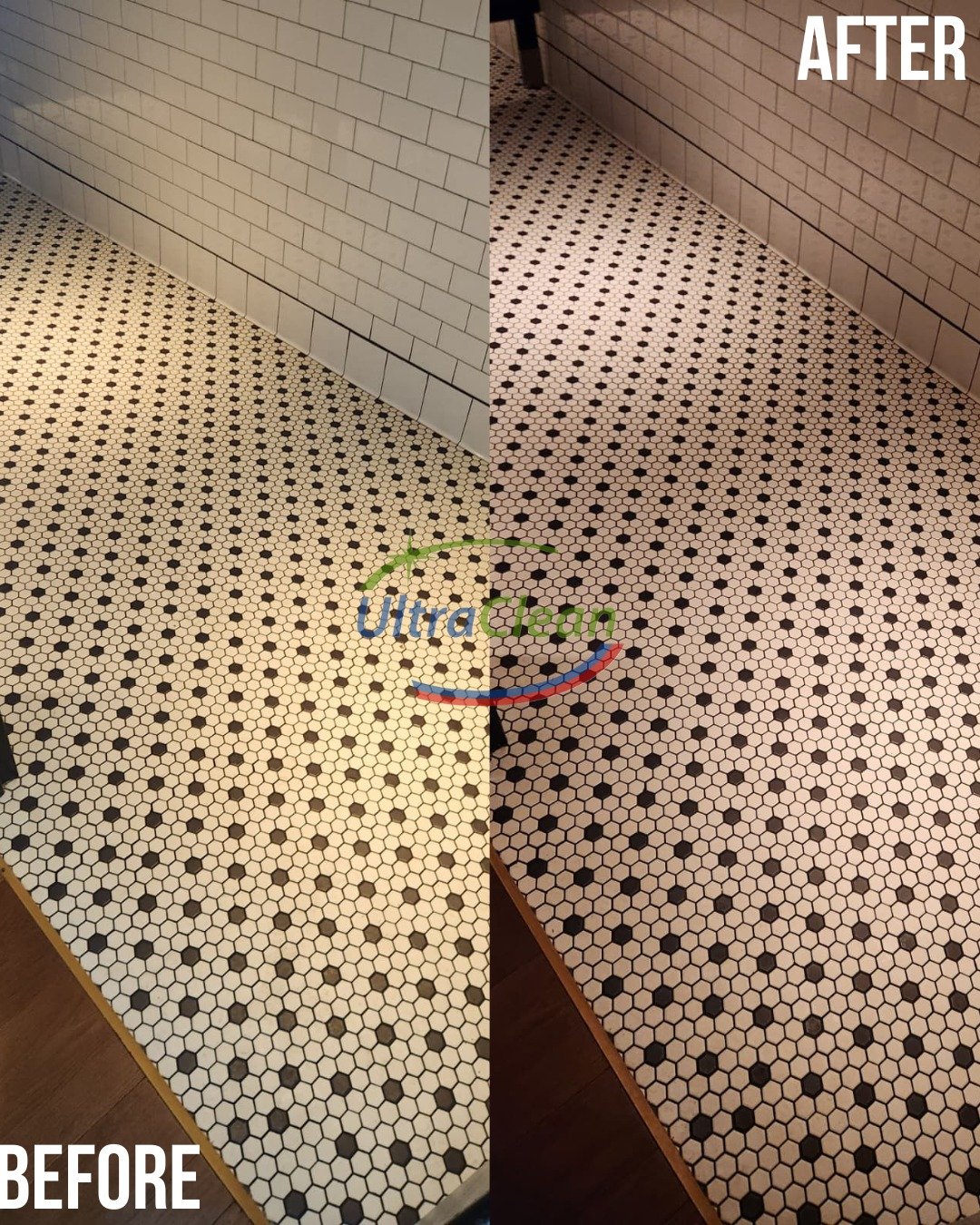
In these cases, professional hot-water extraction at 220–230°F, combined with a high-alkaline pre-treatment, lifts the embedded material out of the pores. The grout returns to within one or two shades of its original color. We then seal it to lock in the result.
Recoloring (Color-Sealing) Works When:
- The grout has absorbed dye-based stains (red wine, hair dye, dark cleaning products)
- The original grout color was inconsistent from installation day
- The homeowner wants to change the grout color entirely (light to dark is common)
- Cleaning gets it most of the way back, but not to a uniform finish
Color-sealing applies a pigmented, urethane-based coating directly to the grout joints. It seals and dyes in one step. Done correctly, it typically lasts 5–7 years in a normal household — and up to 10–15 years in very low-traffic homes (small families or elderly couples). Either way, it’s the most cost-effective alternative to regrouting.
Regrouting Is Necessary When:
- Grout is cracking, crumbling, or missing in sections
- Multiple tiles have hollow spots (you can hear them when tapped)
- There’s underlying moisture damage
What Our Restoration Process Actually Looks Like
Richardson homeowners frequently ask what they’re paying for when they book a professional service. Here’s the sequence on a typical kitchen and entryway job.
Step 1: The 4×4 test patch — done the day of service, not at the estimate. Before we run the full job, we clean a 4×4-foot test area so you can see the actual result on your grout, your lighting, your tile. Roughly 99% of Richardson homes we visit clean up beautifully. For the rare 1% where the staining is too deep, you get three options on the spot — and you decide:
- Color-seal the grout — recolor and seal in one step, fixed price quoted before we move forward.
- Remove and replace — full regrout if the grout itself is compromised.
- Stop, no charge — if neither option works for you, we pack up and you owe us nothing.
The only time we won’t do a test patch is when we’ve already told you during the estimate that we can see in advance the grout won’t come clean (badly cement-burned grout from a previous installer, severe chemical etching from DIY products). Even then, we’ll walk you through your options before we start.
Step 2: Pre-treatment (20–30 minutes). A professional alkaline cleaner is applied to dwell on the grout lines, breaking the bond between the embedded soil and the cement matrix.
Step 3: Hot-water extraction with a turbo head (30–60 minutes per room). A pressurized tool encloses the cleaning area, blasts grout with 220°F+ water at high pressure, and vacuums everything back simultaneously. No mess on your walls or cabinets.
Step 4: Rinse and neutralize. Residual cleaner gets flushed so it doesn’t reattract soil within weeks.
Step 5: Sealing (next-day visit or same-day if conditions allow). A penetrating sealer is applied to every grout line, protecting against future staining for two to four years on cement-based grout.
A standard 200–300 sq ft kitchen typically takes two to three hours start to finish. You can walk on it within an hour after sealing.
Worth a fifteen-minute on-site estimate?
We’re across Richardson every week — Heights Park, Canyon Creek, Cottonwood Heights, Sherrill Park, the UTD-adjacent rentals, and the newer infill builds. Estimates are free, written, and walk you through your options before the truck rolls.
Call (469) 535-9331 or book online at ultracleanfloorcare.com/richardson.
DIY Mistakes That Make Grout Worse
We get called to fix DIY damage roughly once a month. The five most common mistakes:
Bleach on cement grout. Bleach breaks down the cement binder over time. Grout becomes crumbly and even more porous. It also lightens grout unevenly, leaving tiger-stripe patterns.
Vinegar as a regular cleaner. Vinegar is acidic. It eats through sealer fast and slowly etches the cement itself. Fine for an emergency, not as a routine cleaner.
Steam mops on grout (specifically). Steam mops are great for general surface cleaning and disinfecting around the house. The issue with grout is the lack of vacuum recovery — the hot water lifts dissolved soil and pushes it deeper into the porous cement, where it settles right back in as the steam evaporates. Use steam mops freely on sealed surfaces; keep them off grout lines that need actual restoration.
Stiff wire brushes. They abrade the grout surface, opening fresh pores that absorb more stain. Use a soft nylon brush only.
“Whitening” pens. They paint over the grout with a thin coating that peels within months and creates an uneven patchy look you’ll then pay a professional to remove.
If you’ve already tried any of these, it’s not the end of the floor. We can almost always recover it. Just stop before adding another product on top.
When to Call a Pro vs. Stay DIY
Honest take after years of doing this work in Richardson:
Stay DIY if: Your grout shows light, even soil and you’ve kept up with sealing every couple years. A pH-neutral tile cleaner, a soft nylon brush, and patience will maintain it. Annual deep-clean optional.
Call a pro if: You can’t remember when the floor was last sealed, the discoloration is uneven, or you’ve tried cleaning twice and it looks the same. Professional tile and grout cleaning is one of the highest-impact services we offer for the price — the visual difference is dramatic in a single visit.
Skip straight to color-sealing if: Your grout was installed before 2000, has never been resealed, or has permanent stains that survived a professional cleaning. The math on color-sealing beats regrouting every time when the grout structure is still solid. Tech-professional homeowners across Canyon Creek and Cottonwood Heights tend to like this option — pay once, set-and-forget for the next 5–7 years.
Maintenance After Restoration
Once we’ve cleaned and sealed your grout, the maintenance window for keeping it looking new is wider than most people think — but the routine matters.
Weekly: Sweep or vacuum first. Mop with a pH-neutral tile cleaner only. Avoid anything labeled “heavy duty,” “industrial strength,” or “scrubbing bubbles.”
Monthly: Spot-treat any darkening areas immediately with the same neutral cleaner and a soft brush. Don’t let stains sit through a second mopping cycle.
Every 2–4 years: Reseal. A penetrating grout sealer maintained on schedule is the single best investment for long-term tile floors. Sealing alone can extend the life of a deep clean by years.
Year-round: Manage tracked-in soil. A walk-off mat at the garage entry and a second mat just inside catches the grit that wears down grout faster than anything else.
What This Looks Like in Different Richardson Neighborhoods
A quick note on what we typically see by area, because the right approach varies:
Heights Park, Reservation, Richardson Heights (1950s–60s ranches): Original cement grout, often installed before sealers were standard practice. Many homes have been added onto over the decades, so you’ll find a patchwork — original grout in the dining room, a 1990s remodel in the kitchen, a 2018 master bath. Color-sealing is frequently the better long-term call than repeated cleanings on the oldest sections.
Canyon Creek, Country Club Estates (1970s and later expansions): Larger homes with a mix of ceramic, porcelain, and occasional travertine in the bathrooms. Travertine needs different chemistry than ceramic — never use anything acidic on it.
Cottonwood Heights, Sherrill Park (mid-century with strong tech-professional ownership): Many homes have been thoughtfully renovated, often with newer grout but in patches. Owners tend to want a maintenance plan they can set and ignore — color-sealing once, then forget about it for 5–7 years.
UTD-adjacent rentals and infill builds: Property managers handling multiple units value bulk pricing and quick turnarounds between tenants. Newer epoxy or modified grouts in the recent builds are more stain-resistant but show wear at high-traffic transitions; one good professional cleaning usually resets them.
FAQ
How long does professional tile grout cleaning last in Richardson?
With a fresh seal, expect two to four years before grout noticeably darkens again — closer to two in high-traffic kitchens, four in guest bathrooms. Mat placement and the cleaning products you use weekly are the biggest variables.
Can darkened grout be made white again?
Usually yes, if the grout itself is intact. Professional extraction handles most cases. If the original grout was already off-white from installation (common in mid-century Heights Park and Reservation homes), color-sealing in a true white gives a uniform finish that cleaning alone can’t match.
Is steam cleaning safe for grout?
Steam mops are good for general surface cleaning and disinfecting around the house. On grout specifically, though, the lack of vacuum recovery is the problem — steam pushes hot water and dissolved soil deeper into the porous cement, where it settles right back in. For grout restoration, hot-water extraction at controlled pressure with simultaneous vacuum recovery is the safe, effective method.
How much does tile and grout cleaning cost in Richardson?
Cleaning starts at our $150 service minimum, which covers a small bathroom or entry. A typical kitchen of 101–300 sq ft runs $150 to $180 depending on the package. Floors that need a Restoration Clean — stripping old topical sealer, wax, or grout haze before the tile can be cleaned — are priced by the foot at $1.25 per sq ft, about $375 for a 300 sq ft kitchen. A penetrating grout sealer adds $0.55 per sq ft, so cleaning plus sealing on that same kitchen runs $335 to $345. Color-sealing recolors and seals in one step at $2.50 per sq ft — about $750 for a 300 sq ft kitchen — and a topical can go over it for extra protection ($0.95 per sq ft to keep the original look, $1.25 per sq ft for shine across the whole floor). Written estimates are free.
What’s the difference between cleaning and color-sealing?
Cleaning removes embedded soil and restores the original grout color. Color-sealing applies a pigmented coating on top, locking in a uniform color and sealing in one step. Color-sealing typically lasts 5–7 years in a normal household (longer in low-traffic homes); cleaning needs to be repeated every 2–3 years.
Will hard water from Richardson taps re-stain grout after cleaning?
Not quickly, if the grout is sealed. Sealer prevents minerals from being absorbed into the pores. They sit on the surface and rinse off with normal cleaning. Skip the sealer step and you’ll see staining return within 6–12 months.
Can I clean my own grout between professional visits?
Yes — and you should. A pH-neutral cleaner, soft nylon brush, and rinse with clean water is the right weekly routine. Skip anything acidic (vinegar, bleach, “scrub” formulas) and you’ll preserve the seal we apply.
Related services: If you also need tile and grout cleaning in McKinney or marble polishing in Richardson, we run those routes the same week.
Ready to Restore Your Tile and Grout?
Tile and grout that look new again, without replacing a single piece.
Call (469) 535-9331 or visit ultracleanfloorcare.com/richardson for a free written estimate.
The IICRC sets the certification standards that reputable tile and grout cleaners are trained to follow.