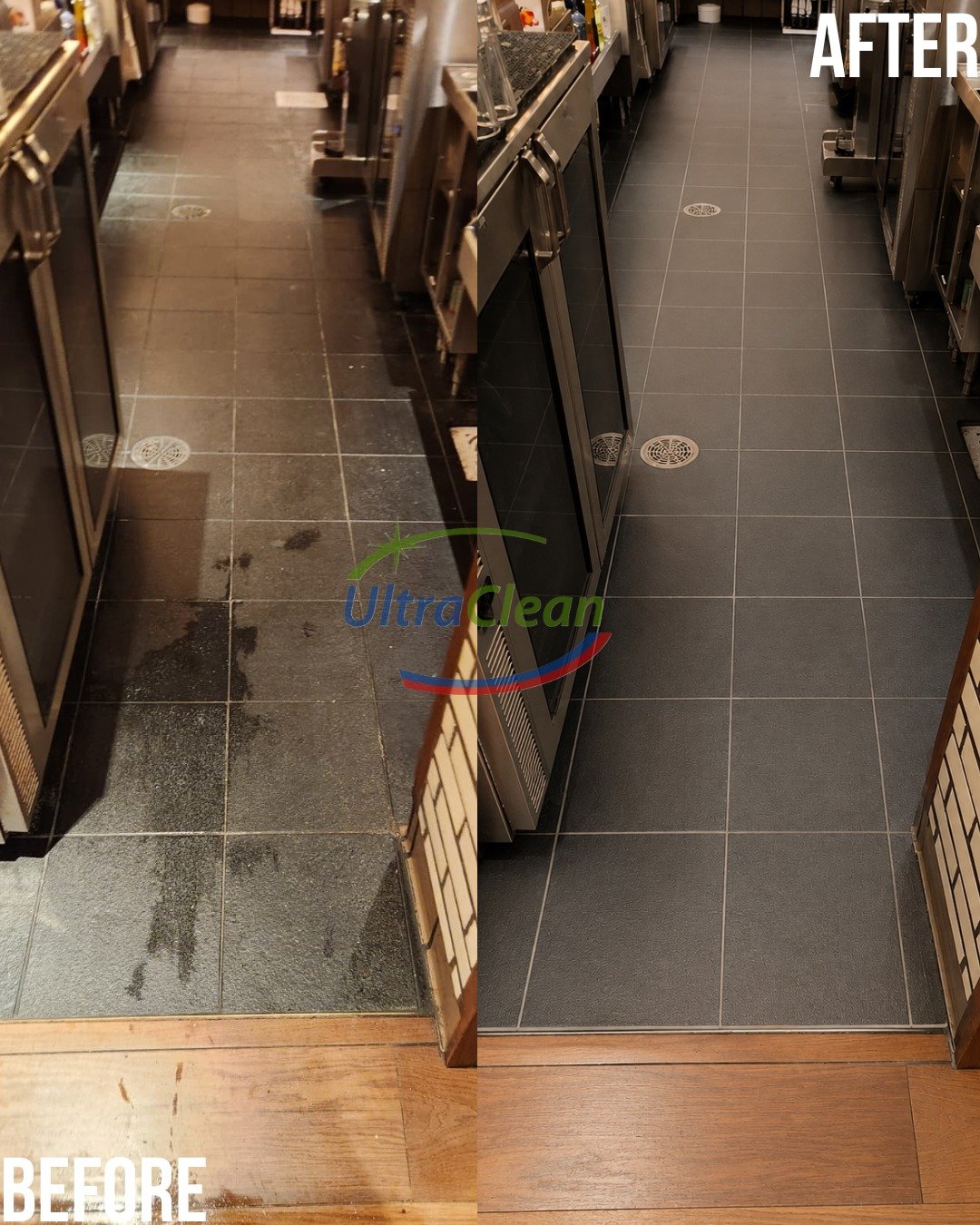
You mopped the kitchen yesterday. Today the grout lines around the island look gray again, almost like you never cleaned them. The tile itself is fine. It’s the thin lines between each piece that keep getting darker year after year.
If you’ve been looking for a professional grout cleaner in McKinney, here’s the honest answer: by the time grout lines look gray or brown, the cement underneath is saturated with hard-water minerals, soap residue, and ground-in soil — and household scrub brushes can’t reach it. Professional tile and grout cleaning uses hot-water extraction to pull that buildup back out, and color-sealing the lines afterward keeps new soil from soaking in. McKinney’s mix of historic downtown homes and master-planned communities means we see grout in everything from 1920s tile floors to 2022 master baths, and the same fix works on both.
This is the most common floor complaint we hear from McKinney homeowners. We see it in Stonebridge Ranch, in the newer sections of Trinity Falls, in the Victorian-era kitchens around downtown, and in the master-planned builds out in Craig Ranch. The cause is almost always the same: porous cement grout absorbing the wrong things faster than mopping can remove them.
The good news is that grout discoloration is almost always reversible. The bad news is that mop water and store-bought spray cleaners are usually making it worse, not better.
Key Takeaways
- By the time grout looks gray or brown, the cement is saturated below the surface — scrubbing cannot reach it.
- Hot-water extraction pulls embedded minerals and soil back out of the lines.
- Color-sealing after cleaning keeps new soil from soaking in and keeps lines uniform.
- The most damaging DIY mistakes are acidic cleaners and stiff brushes that erode the grout itself.
What Grout Actually Is (And Why That Matters)
Most tile grout is a sand-and-cement mixture. Even after it cures, it stays porous. Picture a hard sponge. Anything liquid that touches it gets pulled into those microscopic channels: dirty mop water, cooking grease, pet accidents, kids’ juice spills, and the minerals dissolved in McKinney’s tap water.
That’s why grout darkens unevenly. The heavy-traffic line in front of the sink turns near-black while the grout under the dining table stays pale. You’re not seeing dirt on top of the grout. You’re seeing dirt that’s been pulled into it.
Sealed grout resists this for a while. But sealers wear off, usually within two to three years in a kitchen and four to five in a guest bathroom. Once the sealer is gone, the staining clock starts over.
Why McKinney’s Water Specifically Causes Problems
McKinney’s tap water measures roughly 13 to 15 grains per gallon. The EPA classifies anything over 10.5 gpg as “very hard,” and McKinney sits comfortably in that range. The minerals are calcium and magnesium, and they’re dissolved in every drop that hits your floor.
When that water evaporates from grout lines, the minerals stay behind. Over time they build up as a chalky, off-white film that traps dirt and turns gray-brown. Combine that with North Texas humidity in unconditioned mudrooms and laundry areas, and you get an environment where soap film, mineral deposits, and airborne grease bond together inside the grout.
Mopping pushes that mixture around. It doesn’t lift it out.
The Four Causes We See in McKinney Homes
After more than a decade cleaning floors across Collin County, we can usually predict the cause within thirty seconds of walking in.
Hard-water mineral scale. Most common in kitchens and primary bathrooms. The grout looks evenly dull and slightly gray, not blotchy.
Ground-in soil from foot traffic. Common in entryways off the garage and back doors that lead to the larger lots typical of McKinney. The dark areas follow walking paths, with cleaner grout to the sides.
Sealer failure plus organic staining. Common in bathrooms with kids or pets. Grout shows uneven blotches, sometimes pink (mildew), sometimes yellow-brown (organic residue).
Original grout that was never sealed. Common in the historic downtown McKinney homes built between the 1880s and 1920s, where the original tile in foyers and pantries was set with cement-only grout that’s been absorbing everything for a century. We also see it in pre-2005 ranches across the city where modern penetrating sealers weren’t part of the installation.
Each cause responds to a different process. That’s why one-size-fits-all DIY products usually disappoint. They’re built for surface dirt, not embedded mineral scale or failed sealer.
Can It Be Cleaned, or Does It Need Recoloring?
This is the question every homeowner wants answered before agreeing to a service call. Here’s the honest framework we use on every estimate.
Cleaning works when the grout structure is intact, the discoloration is from soil or mineral buildup sitting in the pores, and a test patch lightens dramatically with the right alkaline cleaner and heat. In those cases, professional hot-water extraction at 220 to 230 degrees, combined with a high-alkaline pre-treatment, lifts the embedded material out of the pores. The grout returns to within one or two shades of its original color. We then seal it to lock in the result.
Color-sealing works when the grout has absorbed dye-based stains, when the original grout color was inconsistent from installation day, or when cleaning gets most of the way back but not to a uniform finish. Color-sealing applies a pigmented, urethane-based coating directly to the grout joints. It seals and dyes in one step.
Done correctly, color-sealing typically lasts 5 to 7 years in a normal household. In very low-traffic homes, like a small family or an elderly couple in a downtown McKinney bungalow, you can sometimes see 10 to 15 years. We do not assume the longer number unless the household traffic actually fits.
Regrouting is the call when grout is cracking, crumbling, or missing in sections, when multiple tiles sound hollow when tapped, or when there’s underlying moisture damage.
What Our Restoration Process Actually Looks Like
McKinney homeowners frequently ask what they’re paying for when they book a professional service. Here’s the sequence on a typical kitchen and entryway job.
The 4×4 test patch, done the day of service. Before we run the full job, we clean a 4-foot by 4-foot test area so you can see the actual result on your grout, your lighting, your tile. About 99 percent of the homes we visit clean up well. For the rare cases where the staining is too deep, you get three options on the spot and you decide: color-seal the grout at a fixed price quoted before we move forward, remove and replace if the grout itself is compromised, or stop with no charge and we pack up.
Pre-treatment. A professional alkaline cleaner is applied to dwell on the grout lines, breaking the bond between embedded soil and the cement matrix.
Hot-water extraction with a turbo head. A pressurized tool encloses the cleaning area, blasts grout with 220-degree water at high pressure, and vacuums everything back simultaneously. No mess on your walls or cabinets.
Rinse and neutralize. Residual cleaner gets flushed so it doesn’t reattract soil within weeks.
Sealing. A penetrating sealer is applied to every grout line, protecting against future staining for two to four years on cement-based grout.
A standard 200 to 300 square foot kitchen typically takes two to three hours start to finish. Cleaning generally runs $240 to $400 depending on size and condition. Cleaning plus sealing runs $460 to $675. Written estimates are free.
DIY Mistakes That Make Grout Worse
We get called to fix DIY damage roughly once a month across McKinney. The most common mistakes:
Bleach on cement grout. Bleach breaks down the cement binder over time. Grout becomes crumbly and even more porous. It also lightens unevenly, leaving tiger-stripe patterns.
Vinegar as a regular cleaner. Vinegar is acidic. It eats through sealer fast and slowly etches the cement itself. Fine for an emergency, not as a routine cleaner. Worth noting for the original tile in downtown McKinney homes especially, since the historic materials don’t tolerate aggressive chemistry the way modern porcelain does.
Steam mops on grout, specifically. Steam mops are good for general surface cleaning and disinfecting around the house. The issue with grout is the lack of vacuum recovery. The hot water lifts dissolved soil and pushes it deeper into the porous cement, where it settles right back in as the steam evaporates. Use steam mops freely on sealed surfaces. Keep them off grout lines that actually need restoration.
Stiff wire brushes. They abrade the grout surface, opening fresh pores that absorb more stain. Use a soft nylon brush only.
If you’ve already tried any of these, it’s not the end of the floor. We can almost always recover it. Just stop before adding another product on top.
Frequently Asked Questions
How long does professional tile grout cleaning last in McKinney?
With a fresh seal, expect two to four years before grout noticeably darkens again. Closer to two in high-traffic kitchens, four in guest bathrooms. The cleaning products you use weekly and the mats at your entry points are the biggest variables.
Can darkened grout be made white again?
Usually yes, if the grout itself is intact. Professional extraction handles most cases. If the original grout was off-white from installation, color-sealing in a true white gives a uniform finish that cleaning alone can’t match.
Is steam cleaning safe for grout?
Steam mops are fine for general surface cleaning. On grout specifically, though, the lack of vacuum recovery is the problem. Steam pushes hot water and dissolved soil deeper into the porous cement, where it settles back in. For grout restoration, hot-water extraction at controlled pressure with simultaneous vacuum recovery is the safe, effective method.
What’s the difference between cleaning and color-sealing?
Cleaning removes embedded soil and restores the original grout color. Color-sealing applies a pigmented coating on top, locking in a uniform color and sealing in one step. Color-sealing typically lasts 5 to 7 years in a normal household. Cleaning alone needs to be repeated every two to three years.
Will hard water from McKinney taps re-stain grout after cleaning?
Not quickly, if the grout is sealed. Sealer prevents minerals from being absorbed into the pores. They sit on the surface and rinse off with normal cleaning. Skip the sealer step and you’ll see staining return within 6 to 12 months.
Related services: If you also need tile and grout cleaning in Plano or marble polishing in McKinney, we run those routes the same week.
Ready to See Your Tile Look New Again?
We’re across McKinney every week, from Stonebridge Ranch and Trinity Falls to the historic downtown blocks and the newer Westridge and Eldorado neighborhoods. Estimates are free, written, and walk you through your options before any work starts.
Call (469) 535-9331 or visit ultracleanfloorcare.com/ for a free written estimate.
The IICRC sets the certification standards that reputable tile and grout cleaners are trained to follow.