A Stonebriar homeowner called us in late September last year. He was hosting his daughter’s wedding rehearsal dinner outdoors in three weeks, and his driveway, walkways, and patio all looked rough after a hard summer. Eighteen-month-old pollen residue, dust, lawn-service grass clippings, oil drips from the second car — all of it had accumulated invisibly until he walked the property at sunset and saw it.
We washed the driveway, the walks, the back patio, and the trash pad in a single visit. The transformation looked unreal in his event photos two weeks later. Frisco power washing requests most often fall into this category: a homeowner preparing for an event sees a year of accumulated grime that has crept up gradually.
What’s worth knowing in Frisco specifically is that the premium finishes that drew people to neighborhoods like Newman Village, Phillips Creek Ranch, and Starwood don’t just stop at the front door. The hardscape is part of the picture — wide stamped-concrete driveways, stone walkways, large covered patios with custom pavers. When that hardscape looks dingy, it pulls down the entire curb-and-entry impression a buyer or guest forms before they ever ring the bell.
Key Takeaways
- Frisco’s two ideal washing windows are spring after pollen season and fall before holiday entertaining.
- Soft washing (low pressure + chemistry) is for siding and stucco; true power washing is for concrete and brick.
- PSI must be matched to each surface — one setting does not fit a driveway, a deck, and siding.
- Rental machines underperform on flow, heat, and chemistry, which is why results fade fast.
Power Washing vs. Soft Washing: An Important Distinction
Before getting into timing, this matters: power washing and soft washing are not the same service.
Power washing uses high-pressure water — typically 1,500–4,000 PSI depending on surface — to physically blast contaminants off durable hard surfaces. It’s the right method for concrete, brick, stone, hardscape, and similar tough exteriors.
Soft washing uses low pressure combined with cleaning chemistry to remove biological growth from surfaces that can’t tolerate high pressure — asphalt shingle roofs, vinyl siding, painted wood. It’s the right method for delicate exterior materials.
Ultra Clean does power washing. We do not do soft washing. If your project requires soft washing — for example, an asphalt-shingle roof streaked with algae, or sun-baked vinyl siding — we’ll tell you honestly at the estimate and point you to a qualified soft-wash specialist in DFW. Mixing up the two services causes damage we get called to fix later.
What We Power Wash
Our power washing scope covers both residential and commercial.
Driveways. Concrete driveways are the most common service in Frisco. Annual washing removes oil drips, tire marks, embedded soil, and pollen-and-mildew darkening at the edges.
Houses (hard-surface exteriors). Brick, stone, stucco, and similar durable cladding can be power washed safely with appropriate technique.
Sidewalks and walkways. Often combined with driveway service.
Parking garages. Multi-level commercial parking structures. Oil staining, tire residue, and accumulated dust make a significant difference once cleaned.
Parking lots. Restaurant, retail, office, and similar commercial parking — including the heavy commercial development around Stonebriar Centre and the Frisco Star.
Decking. Wood and composite deck surfaces, with lower-pressure technique to avoid splintering or gouging.
Trash pads. Often the dirtiest spot on a property. Bacteria, leakage from bags, organic residue. Worth doing alongside driveway service.
Why Timing Matters in Frisco
DFW’s climate creates specific windows that work better than others.
Spring: Best Time for Annual Washing
March through May is the prime window for most residential power washing in Frisco. Two reasons.
First, by mid-March the heaviest pollen drop is over. Washing earlier means much of the work gets recovered by remaining pollen within two weeks. Washing after the peak captures the accumulated year of grime plus the spring pollen surge in one visit.
Second, ambient temperatures in March through May are ideal. Surfaces are warm enough that cleaning chemistry stays active, not so hot that detergent flash-dries before working, and the wash water doesn’t freeze in lines or hoses.
Fall: Best Time for Entertaining Prep
September through November is the second prime window. After summer’s harshest conditions, surfaces have accumulated dust, heat-baked organic material, and weathered residue. Cleaning in early fall sets up the property for outdoor entertaining season through holidays.
Avoid Peak August Heat
August in Frisco routinely sees afternoon temperatures of 100°F or higher, and surface temperatures on dark concrete can climb 30–40°F above ambient. Three risks at this temperature.
Flash-drying detergent. Cleaning chemistry needs minutes of dwell time. On 130°F concrete, detergent dries in seconds, leaving a residue and an incomplete clean.
Surface damage from temperature differential. Spraying cool water on very hot surfaces can cause cracking on some materials.
Worker safety and quality. Crews fatigue faster in extreme heat, and quality drops.
Avoid Hard Freezes in Winter
Frisco winters are mostly mild, but occasional hard freezes (below 28°F for extended periods) make power washing impractical. Water in equipment lines freezes; surfaces can be damaged by ice formation in cracks. We pause power washing during cold snaps and resume when temperatures stabilize.
PSI and Surface Matching
Different surfaces require different pressures. Mismatched PSI is the most common cause of power-wash damage.
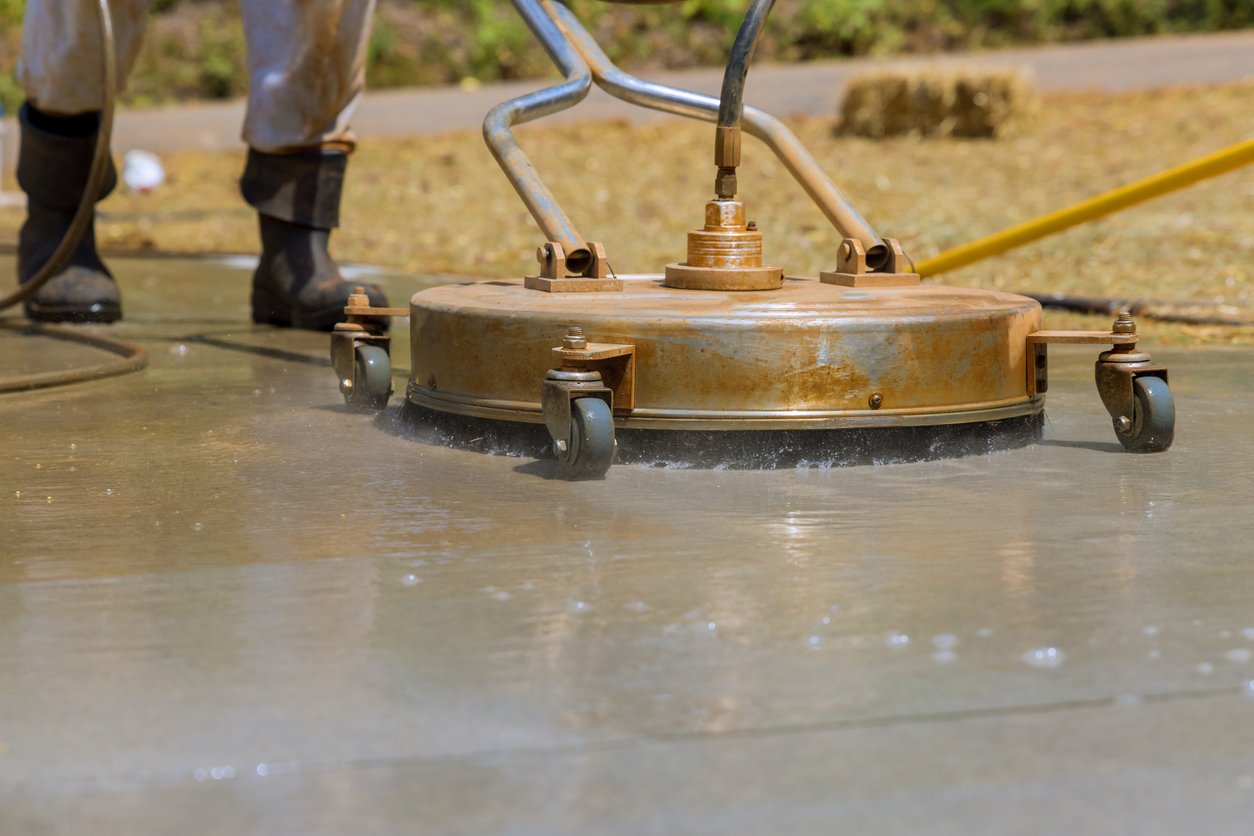
Concrete driveways and sidewalks: 3,000+ PSI with a surface cleaner attachment. The rotating spray gives even results and prevents the wand-stripe pattern that hand-held cleaning leaves.
Brick and stone exteriors: 1,500–2,500 PSI, often with extended-reach wands for upper stories. Higher pressure can blast mortar from older brickwork.
Stucco: 1,500–2,000 PSI maximum. Stucco is more delicate than it looks; aggressive pressure can chip the textured surface.
Wood decking: 500–1,200 PSI. Higher pressure raises the grain, splinters the wood, and gouges softer species.
Composite decking: 1,500 PSI maximum per manufacturer guidance for most brands.
Trash pads: 3,000+ PSI with appropriate detergent. Bacterial residue requires both pressure and chemistry.
Parking lots: 3,000–4,000 PSI with surface cleaner for the open expanse, hand wand for edges and oil spots.
Frisco’s Hard Water Consideration
A specific Frisco detail worth knowing: tap water here measures 13–15 grains per gallon — hard. On most surfaces this doesn’t matter for power washing. On dark concrete, dark brick, and certain stone, mineral spotting can show after the surface dries.
When a homeowner cares about the finished appearance on a dark surface — and in the kind of premium-finish entryways common to Newman Village or Frisco Lakes, this matters — we offer a filtered final rinse that removes the mineral content from the wash water before it hits the surface. This prevents the chalky residue spots that hard water otherwise leaves.
It’s not necessary on every job. For driveways and walkways, the texture of the concrete hides any mineral spotting. For visible vertical surfaces, feature areas, and entry hardscape, it matters more.
Why DIY Rental Power Washers Underperform
If you’ve rented a power washer from a hardware store, you’ve experienced the limits firsthand.
Insufficient PSI for concrete. Most rental units max out at 2,000–2,500 PSI. Useful for some surfaces but inadequate for moderately soiled concrete.
No hot-water option. Commercial-grade power washers heat water to 180°F or more, which dramatically improves cleaning on oil and organic residue. Rental units run cold water.
No surface cleaner attachment. The rotating surface cleaner produces uniform, stripe-free results on driveways. Rental kits typically include only hand-held wands, which leave visible wand stripes against clean concrete.
Insufficient water volume. Power washers are rated by both PSI and GPM. Rental units typically have low GPM, making jobs take 3–5 times longer than equivalent professional work.
For small jobs, rentals can be reasonable. For Frisco-sized driveways, hard exteriors, and large areas, the time and quality difference makes professional service the better value.
What NOT to Power Wash
Some surfaces are not appropriate for power washing at all.
Asphalt shingle roofs. High pressure dislodges the granules that protect shingles from UV. Roofs streaked with algae need soft washing — which we don’t do.
Painted wood siding. Pressure strips paint, drives water under the paint film, and damages the underlying wood.
Vinyl siding when sun-baked. Hot vinyl can warp under pressure.
Sealed wood decks with intact sealer. Power washing strips sealer.
Windows. Pressure can blow seals, damage screens, and force water through weatherstripping into walls.
Electrical fixtures and outlets. Don’t direct pressure at outdoor outlets, fixtures, or wiring penetrations.
Air conditioning condensers. Pressure bends fins and damages coils.
Recommended Frequency
By surface type, based on what holds up well in Frisco’s climate.
Driveways: annually. Once a year keeps them looking new and prevents staining from setting in.
Sidewalks and walkways: annually with the driveway. Same trip, low marginal cost.
Hard exterior cladding (brick, stone, stucco): every 2–3 years for general weathering and pollen buildup.
Decks: before each major outdoor event if used heavily, or every 1–2 years for general maintenance.
Patios: same as decks.
Trash pads: annually with the driveway.
Parking lots and commercial hardscape: annually minimum, more often for high-traffic locations.
Parking garages: every 6–12 months for moderate-use buildings, more often for high-volume commercial.
Frequently Asked Questions
When is the best time of year to power wash in Frisco?
Mid-March through May for spring cleaning and pollen recovery, or September through November for fall and pre-holiday prep. Avoid peak August heat and any hard freeze periods in winter.
How often should I power wash my driveway?
Annually for most Frisco homes. The accumulated pollen, oil drips, tire marks, and weathering build up year-round, and once-a-year washing keeps concrete looking new without becoming a project.
Can power washing damage my driveway or siding?
Yes, with the wrong technique or PSI. Concrete tolerates high pressure; wood, stucco, and certain brick require lower pressure or a different approach entirely. This is why surface-appropriate equipment and technique matters.
How much does power washing cost in Frisco?
Pricing depends on size and condition — written estimates are free, no obligation. Frisco driveways tend to be larger than the regional average, so we walk the property and quote what’s actually there. Call (469) 535-9331.
Do you power wash roofs?
No. Asphalt shingle roofs require soft washing — low pressure plus appropriate chemistry — which we don’t offer. Power washing roofs strips protective granules and shortens roof life. We’re happy to refer you to a qualified soft-wash specialist for roof cleaning.
Can you remove oil stains from my driveway?
Often yes, depending on age and depth of the stain. Fresh oil typically cleans up completely. Older soaked-in stains may lighten significantly without fully disappearing. We assess at the estimate and tell you what to expect.
Related services: If you also need power washing in Richardson or tile and grout cleaning in Frisco, we run those routes the same week. And up the road, carpet cleaning in Wylie TX.
Ready to Refresh Your Property?
A clean property that’s ready for the next event — or the next year. We service Frisco every week, residential and commercial, including Stonebriar, Frisco Lakes, Newman Village, Phillips Creek Ranch, Plantation Resort, The Trails, and Starwood.
Call (469) 535-9331 or visit ultracleanfloorcare.com/ for a free written estimate.
See Also: Power Washing in Other DFW Cities
- When’s the Best Time to Power Wash in Dallas?
- The Best Time to Power Wash Your Home in Plano
- When’s the Best Time to Power Wash in Richardson?
- When’s the Best Time to Power Wash in McKinney?
The National Weather Service Fort Worth forecast is a good check before scheduling exterior washing.