Quick Answer
The US Fire Administration reports roughly 2,900 home dryer fires every year, with failure to clean the dryer accounting for about a third of them and lint as the leading material first ignited. In Richardson, two patterns drive risk: mid-century homes (1950s–70s) with original vent installations that may use undersized or out-of-code materials, and newer two-story infill builds with vent runs of 25–40 feet. Plan on professional dryer vent cleaning every 12–18 months for residential, more often for households doing more than 5–7 loads per week.
By Ultra Clean
IICRC-certified · Family-owned · Serving Richardson since 2013
A Cottonwood Heights homeowner called us in February because her clothes were taking two cycles to dry. She’d cleaned the lint trap religiously for years, so she figured the dryer itself was failing. We pulled the vent termination off the side of her 1965 ranch and found a five-foot plug of compressed lint blocking 90% of the exhaust path — sixty years of accumulation in a vent line that had never been professionally cleaned.
That kind of buildup isn’t unusual. It’s also dangerous. Once lint accumulates that densely inside a hot vent line, the conditions for ignition are present every time the dryer runs. Dryer vent cleaning Richardson residents put off for years is one of the highest fire-risk reductions a homeowner can make in an afternoon.
The Fire Statistics That Actually Matter
The numbers from federal fire safety data are worth knowing before deciding whether this service is “really necessary.”
Roughly 2,900 home dryer fires are reported each year in the United States, according to US Fire Administration data — causing approximately five deaths, 100 injuries, and $35 million in property damage annually. The leading cause is failure to clean the dryer, and lint is the material first ignited in most of these incidents.
The mechanics are simple. Lint is flammable. Dryers produce high heat. When lint accumulates anywhere along the exhaust path — inside the vent line, at the termination, around the dryer cabinet — heat builds up because the system can’t exhaust properly. Heat plus flammable material plus restricted airflow is the ignition triangle.
The good news: dryer fires are highly preventable. Regular cleaning of the lint trap and the vent line eliminates the fuel source. That’s it.
Why Richardson Homes Have Higher Risk Than Average
Two factors specific to housing stock in Richardson raise the dryer fire risk above the national baseline.
Mid-century vent installations that haven’t been updated. Many of the 1950s–70s ranches in Heights Park, Reservation, Country Club Estates, and Richardson Heights have laundry rooms that were originally designed for compact, low-volume dryers — often venting through a short 6–12 foot run to an exterior wall. The original vent material in some of these homes is undersized by modern standards, run through walls without proper support, or terminated with caps that no longer seal properly. We routinely find original 1960s installations that have never been touched.
Long vent runs in newer two-story infill builds. Newer construction tucked into the older neighborhoods often has the laundry room on the second floor or in an interior space well away from an exterior wall. The vent line travels 25–40 feet through walls and ceiling cavities before reaching the roof or exterior termination. Every foot of vent adds resistance and slows exhaust flow, which means lint accumulates faster.
Roof terminations and bird nests. Many Richardson two-story builds vent through the roof rather than a side wall. Roof terminations are vulnerable to bird nests — sparrows and starlings build them inside the termination cap, blocking exhaust completely. We pull out at least one nest per month in spring and summer.
Flexible foil vent hoses behind the dryer. Older installations and some retrofits use crinkly aluminum foil vent hoses between the dryer and the wall. These trap lint inside their ridges and are themselves a fire risk — they’re no longer code-compliant for use behind dryers. Rigid or semi-rigid smooth-walled duct is the correct material.
UTD-adjacent apartments and stacked installations. Many Richardson rentals and some smaller homes have stacked washer-dryer units in closets. Tight space, restricted airflow, and limited service access combine to make these installations harder to maintain and more likely to develop buildup. Property managers often add these to their annual maintenance rotation.
Warning Signs Your Dryer Vent Needs Cleaning Now
You don’t need to wait for a schedule. The dryer tells you when it’s time.
Clothes take longer than one cycle to dry. A properly vented dryer should dry a normal load in 40–60 minutes. If you’re running two cycles or your clothes come out damp, vent restriction is the most common cause.
Clothes are very hot at the end of the cycle. Heat is supposed to leave with the exhaust. If the exhaust path is restricted, heat stays inside the cabinet and clothes come out almost too hot to touch.
The dryer body is hot to the touch during operation. The outside of the dryer should be warm, not hot. A hot cabinet indicates overheating, which often precedes failure of the high-limit safety switch — and in worst cases, ignition.
A burning smell during or after a load. Burning lint has a distinctive scorched-fabric smell. If you notice it, stop the dryer immediately and check the lint trap and vent. Don’t run another load until the vent has been inspected.
Visible lint behind or under the dryer. Lint accumulating where it shouldn’t be is a sign the system is leaking exhaust into the laundry room.
The lint trap stays clean even after multiple loads. This sounds backwards, but it’s a red flag. If lint isn’t reaching the trap, it’s accumulating somewhere upstream of the trap — usually inside the vent line.
Moisture or condensation in the laundry room. Restricted exhaust means moist air is staying inside the room rather than venting outside. Over time this causes drywall damage and supports mold growth — and in Richardson’s hard-water environment (14–16 grains per gallon), that moist air can leave visible mineral spotting on adjacent surfaces.
If two or more of these are present, schedule cleaning soon.
How Often Cleaning Is Actually Needed
Honest ranges based on usage:
Residential, normal household (3–5 loads per week): every 12–18 months. This is the standard recommendation for most Richardson homes.
Residential, high-volume household (6+ loads per week, families with kids, pet bedding washed often): every 9–12 months. Lint accumulates faster when the dryer runs more.
Long vent runs (25+ feet): tighten the interval by a few months. Longer runs accumulate more lint per cycle because more lint stays in the line rather than reaching the exterior.
Mid-century homes with original vent installations: First-time professional inspection regardless of when you last did anything — there may be decades of buildup. After that, follow the normal schedule.
Commercial laundry (apartment-building shared laundry, salon laundry, dog-grooming towels, restaurant linens): quarterly minimum, often more often. Commercial dryers run nearly continuously and build lint at multiplied rates.
UTD-area rentals: at tenant turnover. Property managers in the rental corridor often bundle vent cleaning with carpet cleaning between tenants.
New installation or new home: Inspect in the first 6 months even if usage is light. Construction debris and installation lint can accumulate quickly during the break-in period.
After bird nest season (spring through summer): Roof-terminated vents should be inspected for nests every fall.
Not sure how long it’s been since your vent was cleaned?
If you can’t remember, it’s been long enough. We service dryer vents across Richardson — Heights Park, Canyon Creek, Cottonwood Heights, Sherrill Park, Country Club Estates, and the UTD-area rental corridor — and inspections are quick.
Call (469) 535-9331 or visit ultracleanfloorcare.com/richardson.
Our Inspection and Cleaning Process
Here’s what professional dryer vent cleaning actually involves on a typical Richardson home.
Step 1: Visual inspection of the dryer area. We check the lint trap, the connection between the dryer and the wall, the type of duct material in use (flexible foil hoses get flagged for replacement recommendation), and any visible signs of lint accumulation around the dryer cabinet.
Step 2: Termination inspection. We locate the exterior termination — side wall or roof — and inspect it for nest material, damper function, and obstruction. On roof terminations we check the cap.
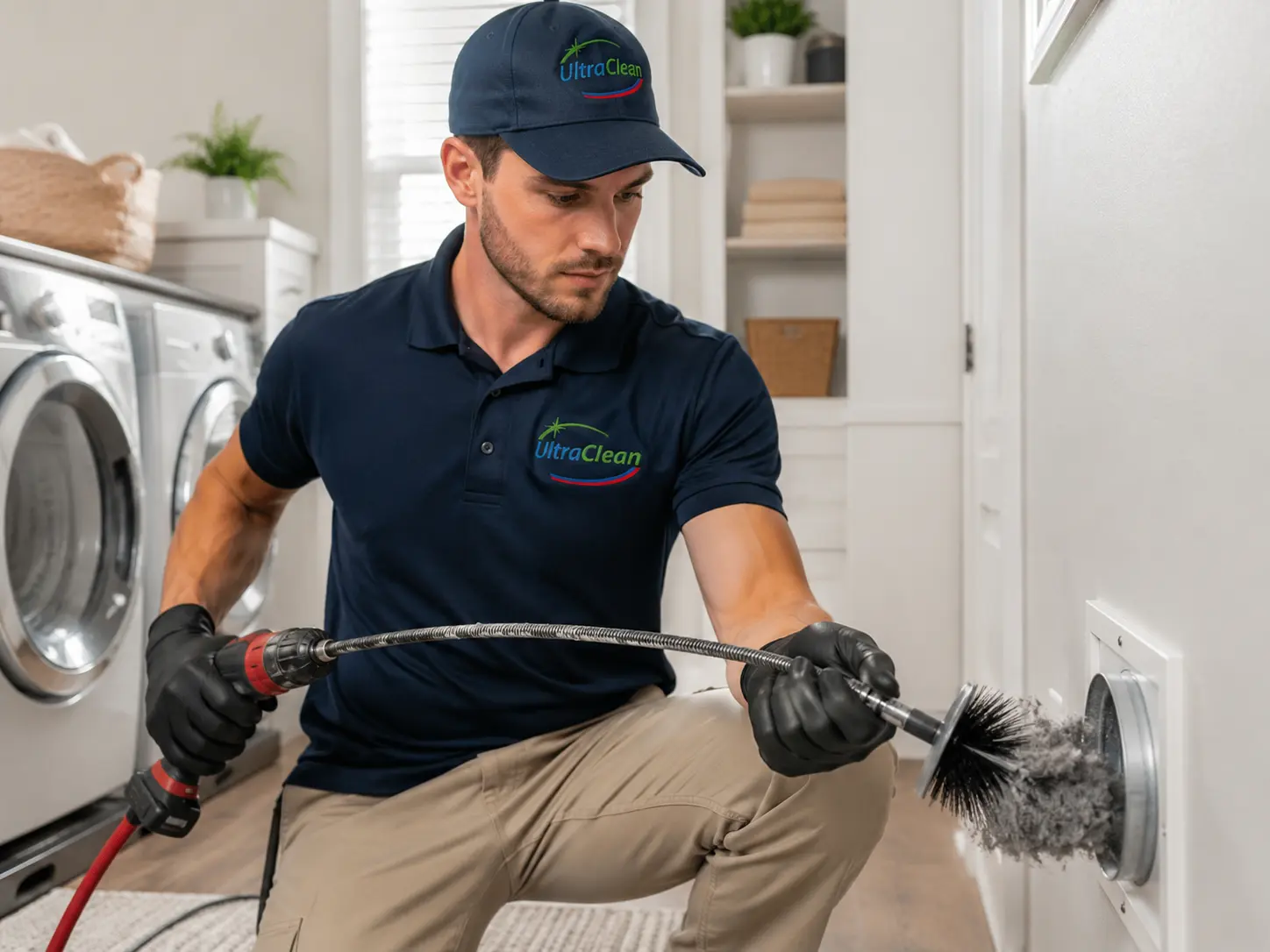
Step 3: Rotary brush cleaning from both ends. A flexible drive shaft with a rotating brush head is fed into the vent line, scrubbing the interior walls as it rotates. We work from both ends — pushing through from the dryer side and pulling through from the termination side — to capture lint that’s compressed into corners and elbows.
Step 4: HEPA vacuum recovery. A high-CFM vacuum captures the dislodged lint at one end while the brush works. This ensures lint exits the system rather than redistributing inside the duct or your laundry room.
Step 5: Behind-the-dryer cleaning. We pull the dryer out, clean the lint accumulated on the back of the cabinet and around the floor, and reconnect the vent hose with proper clamps. Many homes have years of lint buildup behind the dryer that’s never been touched.
Step 6: Test run and airflow verification. We run the dryer for a few minutes to confirm proper exhaust flow at the termination. Strong, consistent airflow with no lint discharge confirms the system is clear.
A standard residential cleaning takes 60–90 minutes. Longer vent runs or roof terminations add time. Commercial systems take longer still depending on configuration.
What You Can DIY vs. What Needs a Pro
Honest take on what’s reasonable to do yourself.
DIY-friendly:
- Clean the lint trap before every load. Every single time.
- Wipe down the lint trap housing monthly with a damp cloth — fine lint particles accumulate inside the screen housing.
- Pull the dryer out once a year, vacuum behind it, and inspect the vent hose connection.
- Inspect the exterior termination occasionally to ensure the damper opens when the dryer runs and there’s no visible obstruction.
Pro-required:
- Cleaning the full vent line. The equipment needed — long rotary brushes, high-CFM vacuum, push rods — isn’t practical for one-time use, and improperly cleaned vents can be damaged.
- Roof terminations. Don’t go on your roof for this.
- Long vent runs through interior walls or ceiling cavities.
- Replacing crinkly foil vent hoses with rigid metal duct.
- Diagnosing why drying times have slowed when the cause isn’t obvious.
If you’ve never had your vent professionally cleaned — common in mid-century Richardson homes where the original installation has just kept running — the first service is also a baseline inspection that tells you what condition the system is in and how often you should be scheduling cleaning going forward.
Pairing Dryer Vent Cleaning With Air Duct Cleaning
These are two distinct services that solve two distinct problems. Don’t let anyone tell you they’re the same thing.
Air duct cleaning addresses the HVAC system — the supply and return ducts that distribute heated and cooled air through your home. It’s primarily an indoor air quality service.
Dryer vent cleaning addresses a single dedicated exhaust line that runs from the dryer to the outside. It’s primarily a fire prevention service.
The two systems don’t connect. Cleaning one does not clean the other. That said, scheduling both during a single visit is a common request among our tech-professional Telecom Corridor clients who like to bundle annual maintenance — we can do both efficiently in the same trip if the timing works.
FAQ
How often should I get my dryer vent cleaned in Richardson?
Every 12–18 months for a typical residential household running 3–5 loads per week. Tighter intervals for high-volume households, longer vent runs, or commercial use. If clothes are taking longer than one cycle to dry, schedule cleaning regardless of the calendar.
Is the lint trap the same as the dryer vent?
No. The lint trap catches a fraction of the lint produced during drying. The rest passes through the trap and accumulates inside the vent line that runs from the dryer to the outside. Cleaning the lint trap doesn’t clean the vent.
How much does dryer vent cleaning cost in Richardson?
Pricing depends on size and condition — written estimates are free, no obligation. Call (469) 535-9331.
Can I clean my dryer vent myself with a kit from the hardware store?
You can clean short, accessible vent runs with a DIY rotary kit. Long runs, second-story installations, roof terminations, and any vent with multiple elbows are best handled professionally. Improper DIY cleaning can damage the duct or push lint further into hard-to-reach areas.
What kind of dryer vent material should I have?
Rigid metal duct or UL-listed semi-rigid metal duct for the vent line through walls and ceilings. Behind the dryer, a short section of semi-rigid metal can be used to allow the dryer to be pulled out for service. Crinkly aluminum foil hoses are no longer code-compliant and should be replaced — common upgrade we make in mid-century Richardson homes.
Why is my dryer vent terminating into the attic?
It shouldn’t be. Dryer vents must terminate outside the home — through an exterior wall or the roof. Terminating into an attic or crawlspace introduces moisture and lint into spaces where they cause damage and fire risk. If you find this in your home, it should be corrected immediately.
Do gas dryers need vent cleaning more often than electric?
Both need cleaning at similar intervals based on usage. Gas dryers have an additional safety concern — combustion gases (including carbon monoxide) must vent properly. A blocked vent on a gas dryer can push exhaust back into the home, so prompt attention to drying-time issues is especially important.
Related services: If you also need dryer vent cleaning in McKinney or air duct cleaning in Richardson, we run those routes the same week.
Ready to Lower Your Fire Risk?
Lower fire risk in an afternoon. Faster drying times. Lower energy bills.
Call (469) 535-9331 or visit ultracleanfloorcare.com/richardson for a free written estimate.
Fire-safety data from the National Fire Protection Association shows why keeping dryer vents clear matters.