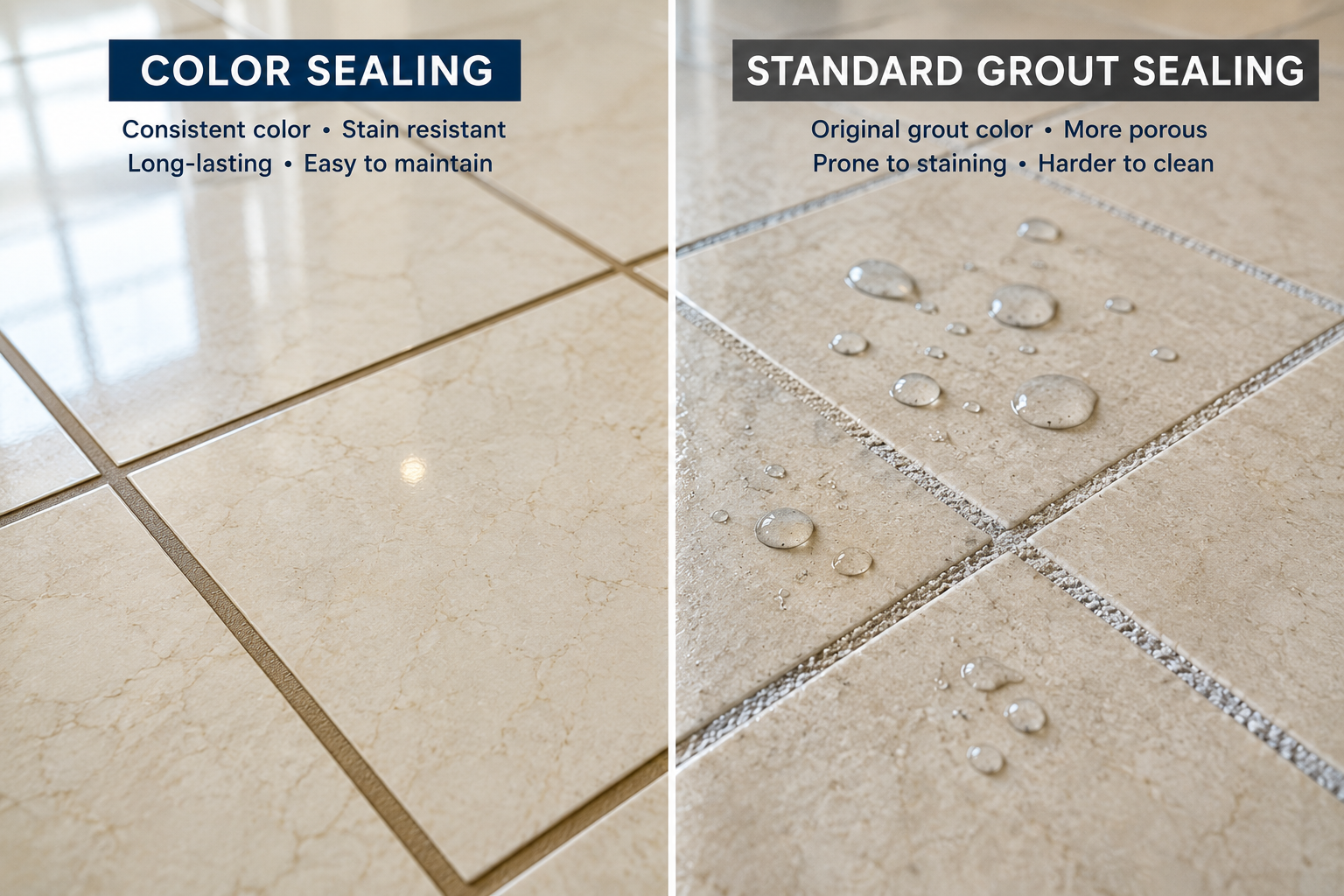
The short answer: a standard (penetrating) grout sealer soaks invisibly into the grout to repel water and stains — it protects but doesn’t change the look. Color sealing is a pigmented coating bonded onto the grout surface that both seals and recolors it to a uniform shade, hiding permanent stains and letting you change the color entirely. Penetrating sealer is for grout that’s still a good color; color sealing is for grout that’s permanently stained, blotchy, or that you want a different color.
Key Takeaways
- Penetrating/standard sealer — invisible, soaks in, repels stains, keeps grout’s natural look.
- Color seal — a pigmented topcoat that seals and gives grout a uniform, restored color.
- Color sealing also hides permanent staining that cleaning alone can’t remove and lets you switch grout color.
- Color seal generally lasts longer and resists staining more aggressively; it costs more per square foot.
- Both should go on clean, dry grout — sealing over dirty grout locks the dirt in.
The Core Difference: Soaks In vs. Coats On
Both protect porous grout, but they work in opposite ways. A penetrating sealer (also called an impregnating sealer) is absorbed into the grout’s pores, leaving no visible film — the grout looks exactly the same, just protected. Color seal is applied on top as a pigmented, bonded layer that fills and coats the grout, giving it a fresh, even color and a built-in stain barrier. Think of penetrating sealer as invisible armor, and color seal as a fresh coat of protective paint made for grout.
Side-by-Side Comparison
COLOR SEALING vs. PENETRATING GROUT SEALING
| Penetrating (Standard) | Color Seal | |
|---|---|---|
| How it works | Soaks into pores | Pigmented coat on surface |
| Changes the look? | No (invisible) | Yes (uniform new color) |
| Hides permanent stains? | No | Yes |
| Change grout color? | No | Yes, any color |
| Stain resistance | Good | Excellent |
| Relative cost | Lower | Higher |
When to Choose Penetrating (Standard) Sealer
Pick a standard penetrating grout sealer when your grout is still a good, even color and you simply want to protect it after cleaning. It keeps the natural look, repels the spills and North Texas hard-water minerals that would otherwise soak in, and makes routine mopping more effective. It’s the default recommendation after most tile and grout cleanings — the affordable way to make clean grout stay clean longer.
When Color Sealing Is the Better Call
Choose color sealing when cleaning alone won’t get you where you want to be:
- Permanently stained or blotchy grout — years of embedded staining that deep cleaning brightens but can’t fully even out.
- Uneven color — patchy grout that never looks uniform no matter how it’s cleaned.
- You want a different color — going darker (hides dirt) or matching a new design.
- Maximum stain protection — the bonded coat resists staining more aggressively than a penetrating sealer.
Because color seal lays down a fresh, uniform surface, it’s often the answer for grout that’s stuck looking dirty even after a thorough cleaning — the situation many homeowners hit in our why grout turns dark guide.
One Rule for Both: Clean and Dry First
Whichever you choose, it only works on clean, dry grout. Sealing over dirty grout traps the soil underneath — with color seal, you’d literally lock the stains in under the new coat. That’s why sealing is done as the final step after a professional tile cleaning service, never as a shortcut to skip it.
Grout Sealing & Color Sealing in DFW
Penetrating sealer to protect good grout, or color seal to restore an even color and hide permanent stains — applied after a proper cleaning. Free estimate.
Frequently Asked Questions
What’s the difference between color sealing and regular grout sealing?
Regular (penetrating) sealer soaks invisibly into the grout to repel stains without changing its look. Color sealing applies a pigmented coating on top that both seals the grout and gives it a uniform, restored color — and it can hide permanent stains or change the color entirely.
Does color sealing hide stained grout?
Yes. Because it’s a pigmented coat bonded over the grout, color sealing covers permanent staining and blotchiness that cleaning alone can’t remove, leaving a uniform color.
Which lasts longer?
Color sealing generally lasts longer and resists staining more aggressively than a penetrating sealer, because it forms a bonded protective surface. It also costs more per square foot.
Can I seal grout myself without cleaning it first?
No — sealing must go over clean, dry grout. Sealing dirty grout traps the soil underneath, and with color seal you’d lock the stains in permanently. Always clean first.
Ultra Clean is IICRC-certified and has served Dallas–Fort Worth since 2013. Our methods follow the standards set by the IICRC.