Protecting Hardwood Floors in Dallas Homes

Walk into a 1928 bungalow in the M Streets and you’ll find narrow-board white oak running through every room, finished and refinished over a century of owners. Walk into a 2023 high-rise condo in Uptown and you’ll see seven-inch wide-plank engineered oak across the entire main floor.

Same city. Same climate. Two completely different floors that need to be cared for in completely different ways. Get them mixed up — use the wrong cleaner, ignore the wrong warning sign — and you’re looking at warping, cupping, or finish failure that costs thousands.

By Ultra Clean. Family-owned, serving Dallas since 2013.

The Three Dallas Wood Floor Archetypes

Archetype 1: Pre-War Solid Hardwood

These are the floors in Lakewood, the M Streets, Oak Lawn, and parts of Oak Cliff. Often original to homes built in the 1920s, 30s, and 40s. Narrow-board white or red oak, sometimes pine, nailed to wood subfloors over pier-and-beam foundations.

Most of these floors have been sanded and refinished two or three times across their lifetime. Many show character marks — vintage gaps, slightly off-color repairs from decades of plumbing work, a slight cup in the dining room from a long-ago leak.

Strengths: These floors are remarkably resilient. With proper care, a 1928 white oak floor still has decades of life left.

Vulnerabilities: Pier-and-beam foundations move with seasonal soil moisture. Cup-and-crown cycles are more pronounced than on slab-foundation homes. Older finishes are often worn through in traffic paths.

Archetype 2: Mid-Century and Late 20th-Century Solid Wood

Preston Hollow, Lake Highlands, and parts of Oak Cliff have a lot of 1960s–90s homes with site-finished solid oak — typically 2-1/4-inch strip width nailed to plywood over slab. Polyurethane finishes from the 80s and 90s are common and often near the end of their service life.

Strengths: Solid wood can be sanded and refinished multiple times.

Vulnerabilities: Old polyurethane wears through in patterns — entryway, in front of the kitchen sink, in front of the laundry. Pet stains may be baked in.

Archetype 3: Engineered Hardwood in Uptown, Downtown, and Bishop Arts

Newer high-rise condos and urban infill homes typically have engineered hardwood — a real wood veneer (usually two to four millimeters thick) glued to a plywood or HDF core. Factory-finished with aluminum oxide coatings that are much harder than site-applied polyurethane.

Strengths: More dimensionally stable. Tougher factory finish resists scratches.

Vulnerabilities: The veneer layer is the only sandable material. Most engineered floors can only be refinished once, sometimes twice. Cheaper engineered products can’t be refinished at all.

How Dallas Humidity Swings Affect Each Type

Dallas indoor relative humidity can range from under 25% in January to over 60% in July and August. That swing is the single biggest stressor on any wood floor.

Wood is hygroscopic — it absorbs moisture when humidity is high and releases it when humidity is low. Boards expand and shrink with that exchange.

On older solid hardwood in pre-war homes: Winter brings visible gaps between boards. Summer brings cupping — edges raise higher than centers. We frequently see decades of accumulated cupping in older Lakewood and M Streets kitchens and baths.

On engineered wood in Uptown high-rises: Micro-gaps at click-lock joints in winter, edge swelling in summer. The factory finish wears through faster at corners that have puffed up slightly.

The fix starts with stabilizing humidity in the 35 to 55% range year-round. A whole-house humidifier in winter and reliable AC dehumidification in summer make a substantial long-term difference.

Dallas Water Hardness and Your Floors

Dallas tap water sits at 14 to 17 grains per gallon. That matters for wood floors in one specific way: damp-mopping with hard tap water leaves mineral residue behind that builds up as a cloudy haze on the finish. Over time the residue holds soil and looks dingy even when freshly cleaned. Our professional cleaning process uses deionized water for the final rinse to leave no mineral residue on the finish.

Our Three-Step Decision Path for Dallas Hardwood

We don’t screen-and-recoat and we don’t sand-and-refinish. If your floor genuinely needs to be sanded to bare wood, we’ll tell you that honestly and recommend a refinisher. What we do — and do well — is everything that comes before refinishing, which keeps most floors looking great for years longer than homeowners expect.

Path A: Revitalizing Clean

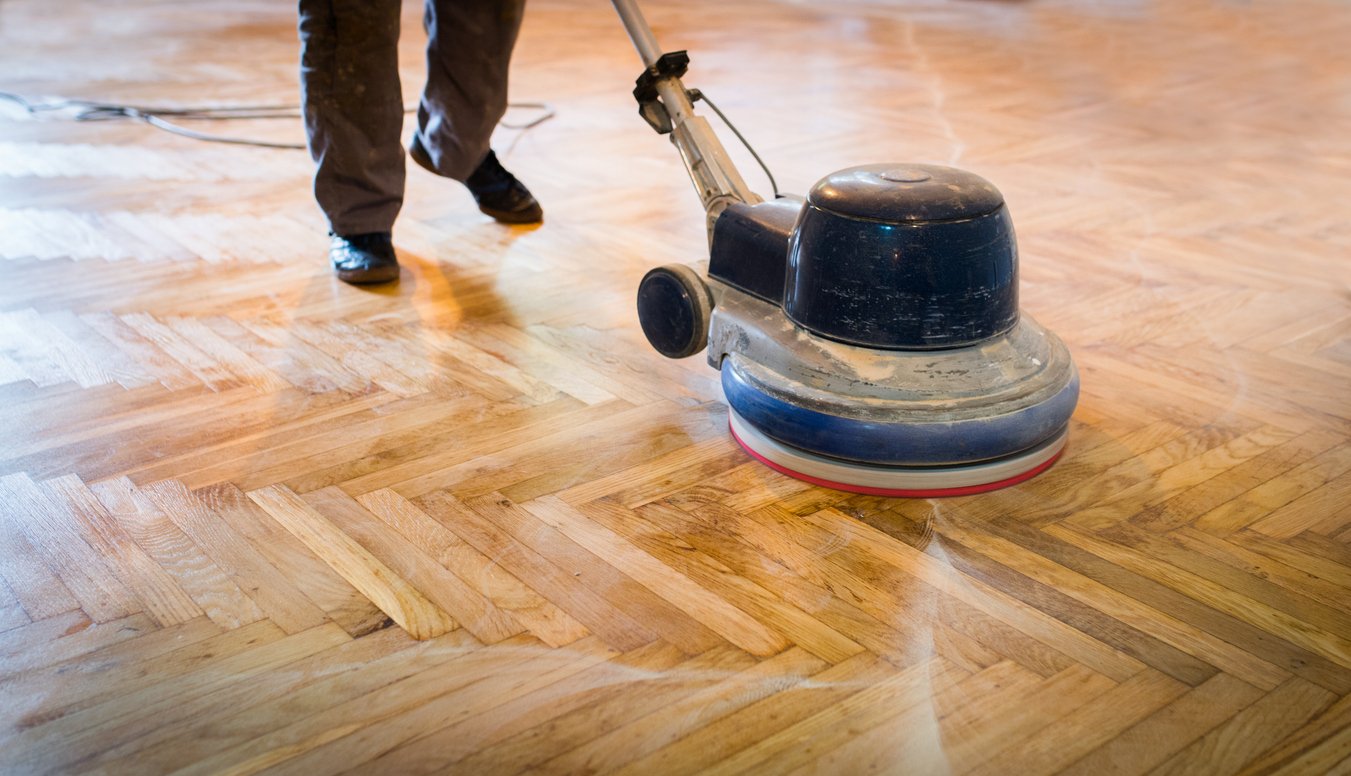
A professional deep clean removes embedded grime, old cleaning residue, and surface contaminants without touching the finish. We use a wood-safe cleaning solution and a low-moisture extraction process — no flooding, no standing water.

On solid hardwood with sound polyurethane, this restores 80 to 90% of the original look. On engineered hardwood with factory finish, often closer to 95%. Cost: typically $0.60 to $1.20 per square foot. Lasts 12 to 18 months with normal maintenance.

Path B: Wax-and-Buildup Strip + Natural Polish

If your floor has had years of acrylic polish or wax buildup (Murphy’s Oil Soap, Bona Refresher, Quick Shine, anything from the supermarket wood-care aisle), revitalizing cleaning alone won’t get through it. The buildup needs to be stripped first, then the wood gets a natural polish that brings the sheen back.

This is common in older Lakewood and Preston Hollow homes where the floors were touched up with grocery-store products for years. Cost: typically $0.95 to $1.50 per square foot.

Path C: Revitalization (Urethane Top-Coat)

We call this service Revitalization. When the underlying finish is still intact but has lost its shine, we apply a urethane coating over the existing polyurethane that gives the floor a renewed gloss and adds a fresh protective layer — without sanding, staining, or the dust of a full refinish.

This is not a screen-and-recoat (which abrades the existing finish first) and not a refinish (which removes the existing finish entirely). Revitalization is a top-coat that bonds to the cleaned, prepped existing finish.

Together, Revitalizing Clean + wax-and-buildup strip + Revitalization typically buy you 3 to 7 more years before any sanding-and-refinishing might be needed. Cost: typically $0.75 to $1.25 per square foot for the top-coat itself.

What NOT to Use on Wood Floors

Acrylic-based polishes leave a film that traps dirt. Over time it builds up into a cloudy, uneven layer that no normal cleaning removes.

Murphy’s Oil Soap and oil-based cleaners leave residue that prevents future refinishing products from bonding.

Steam mops on wood. The single most damaging tool we see in wood-floor homes. Steam forces moisture through the finish into the wood. On engineered floors it can delaminate the veneer. On solid wood it causes long-term swelling and finish failure. Don’t use one on wood, period.

What we use instead: a pH-neutral, residue-free wood cleaner combined with low-moisture mechanical extraction.

Year-Round Maintenance Routine

Daily: Sweep or dust-mop high-traffic areas. Microfiber works best.

Weekly: Damp-mop with a pH-neutral wood floor cleaner using a barely-damp pad, never a sopping mop.

Monthly: Check the humidity. Keep it between 35 and 55%.

Quarterly: Inspect entryways, the kitchen sink area, and pet zones for early wear. Refresh furniture pads.

Annually: Professional hardwood deep clean. Every 12 to 18 months minimum.

Frequently Asked Questions

How can I tell if my Dallas home has solid or engineered hardwood?

Look at an exposed edge — at a vent register, a transition, or a staircase. Solid wood shows continuous grain top to bottom. Engineered shows visible layers, like plywood, with a thin wood veneer on top. Most Lakewood, M Streets, and Preston Hollow homes have solid. Most Uptown and Bishop Arts builds have engineered.

How often should I deep-clean my hardwood floors in Dallas?

Every 12 to 18 months for professional cleaning. With kids, pets, or heavy entertaining, lean toward 12. The cost is minimal compared to sanding-and-refinishing, and it dramatically extends the time before sanding is ever needed.

What’s the cheapest way to make old hardwood floors look better in Dallas?

A professional revitalizing clean, plus a wax-and-buildup strip if needed, plus Revitalization (urethane top-coat over the existing finish). Together these typically cost a fraction of sanding-and-refinishing and buy you 3 to 7 more years before sanding is ever needed.

Can engineered hardwood be refinished?

Sometimes, by a refinishing specialist. It depends on veneer thickness. Engineered floors with 3mm+ veneer can be sanded and refinished once, occasionally twice. Cheaper products with 1mm or less veneer cannot.

Do I need to refinish before selling my Dallas home?

Usually no. A deep clean, wax strip, and Revitalization is enough to impress buyers without the cost and disruption of a full sand-and-refinish. Clean, glossy floors look new in photos.

Related services: If you also need hardwood floor cleaning in Frisco or tile and grout cleaning in Dallas, we run those routes the same week. And outside, we also offer power washing in Dallas. And up the road, hardwood floor cleaning in Forney TX.

Ready to Protect Your Dallas Hardwood?

Wood floors that hold their value for decades, not just years. We work across Dallas every week — Lakewood, the M Streets, Preston Hollow, Lake Highlands, and the Uptown high-rises.

Call (469) 535-9331 or visit ultracleanfloorcare.com for a free in-home assessment.

What We Offer

The Services We Offer Across The DFW Metroplex

Every service we provide is backed by quality, precision, and your satisfaction. Discover the Ultra Clean difference and enjoy a cleaner, healthier, and more inviting home, without the stress.

Tile and Grout Cleaning

Experts in Tile and Grout Cleaning

Marble Polishing

Delicate Stone Polishing

Air Duct Cleaning

Air Duct Cleaning Experts

Carpet Cleaning

Professional Carpet Cleaning

Pet Treatment

Guaranteed Pet Stain Removal

Upholstery Cleaning

Upholstery Cleaning Care

Rug Cleaning

Oriental Rug Cleaning

Wood Cleaning

Wood Cleaning & Revitalizing

Power Washing

Professional Power Washing

Testimonials

Satisfaction Guaranteed!

Every floor tells a story, let us help make it last…


Help & FAQ

Common Questions About Our Services

When you’re ready for fresher, healthier floors, just reach out to get started. We’ll begin with a free, no-obligation proposal. From there, you can relax knowing every service is backed by our satisfaction guarantee.

Any questions you want to ask?

When you’re ready for cleaner, healthier floors, simply contact us to begin. Next, we provide a free proposal before any service. Then relax knowing our satisfaction guarantee protects every job.

We are based in Dallas and primarily serve the North Texas area including Plano and Collin County. While we travel throughout the Metroplex for larger restoration projects, our residential packages are focused on our local service radius to maintain our high standards.

Absolutely. We exclusively use eco-friendly, family-safe, and non-toxic solutions to ensure your home is healthy and free of harsh chemical residues.

Typically, carpets are dry within 4 to 6 hours. We utilize high-velocity air movers during the process to speed up evaporation so you can get back to your routine quickly.

The Refresh package is a standard hot water extraction for routine maintenance. The Deep Clean includes mechanical CRB scrubbing to break up heavy soil before extraction for a deeper restoration.

Yes! We offer a 30-day satisfaction warranty on most cleaning services and a full 1-year warranty on our specialized grout coloring and restoration projects.

The Cities We Service

Based in Dallas, we primarily serve Dallas County and the surrounding North Texas area. While we do handle larger restoration projects throughout the DFW Metroplex, our standard cleaning packages are focused on our immediate local communities to ensure prompt, high-quality service.

Ultra Clean logo
floor cleaning

Fulfill This Form