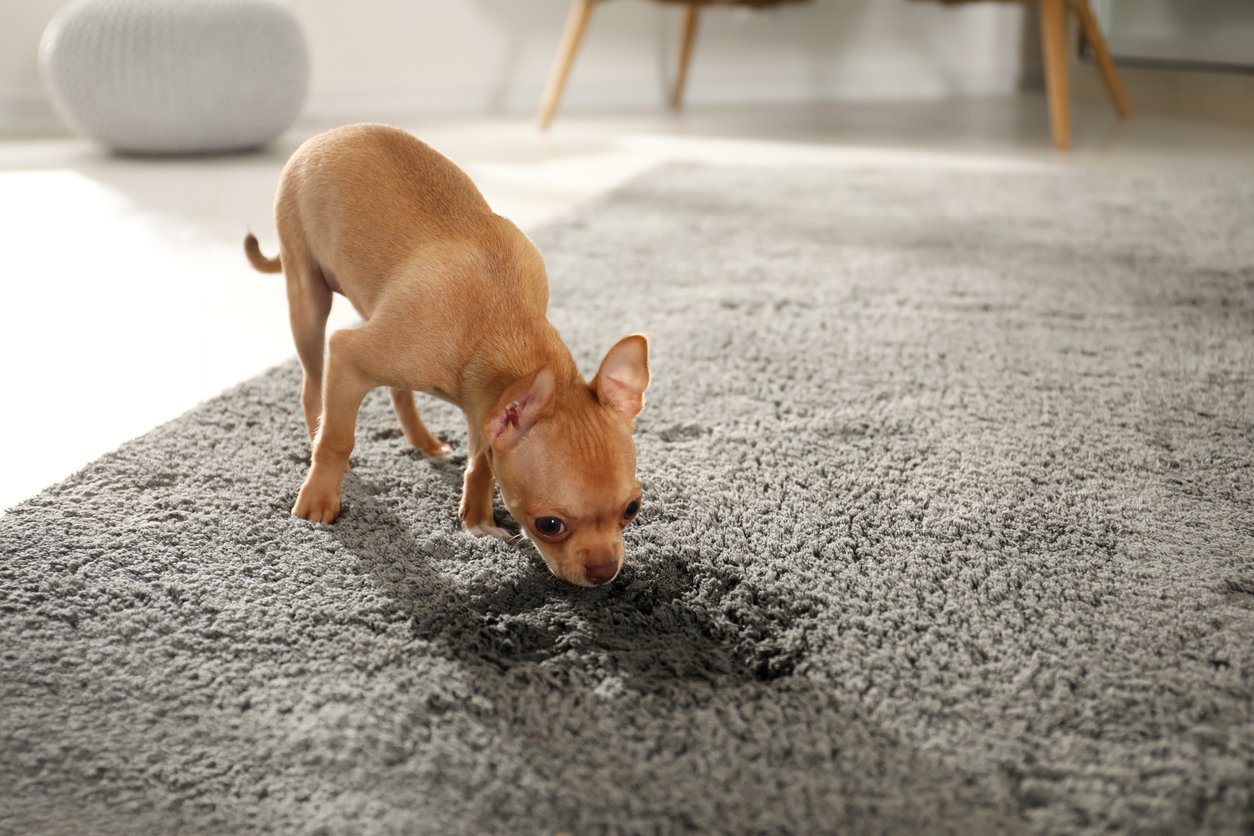
A Lakewood family called us six weeks after they had “cleaned” a major dog accident in their primary bedroom. The surface stain was gone. The smell was gone for about two days. Then it came back stronger, and on warm days it was unbearable.
This is the most predictable failure mode in DIY pet odor work. The carpet face fiber gets cleaned, the surface stain disappears, the smell briefly fades, and then the urine that soaked into the pad and subfloor recrystallizes, reactivates with humidity, and the odor returns. Real pet stain odor removal has to address what’s below the carpet, not just what’s on top.
By Ultra Clean. Family-owned, serving Dallas since 2013.
Why Pet Urine Is So Hard to Remove
Pet urine isn’t a normal stain. It’s chemically active in ways that ordinary spills aren’t.
It crystallizes. As urine dries, urea breaks down and uric acid crystals form. These crystals are insoluble in plain water. You can soak a contaminated carpet for hours and they won’t dissolve. Only specific enzyme treatments designed to break down uric acid will release them.
It penetrates deep. Liquid urine doesn’t sit on top of the carpet. It runs down through the carpet face, through the backing, into the pad, and often into the subfloor. The face fiber holds maybe 10% of the total volume. The other 90% is below where you can see.
It feeds bacteria. Bacteria living in the urine and on the surrounding fibers consume the protein and excrete ammonia. The ammonia smell that “comes back” after cleaning is bacterial metabolism, not the original urine reactivating.
It reactivates with humidity. Crystallized uric acid becomes liquid again when humidity rises. In Dallas summers, when indoor RH can climb above 60% if AC can’t keep up, spots that seemed cured in winter come roaring back in July.
Cat urine is worse than dog urine. Cat urine has higher concentrations of urea, uric acid, and a sulfur compound called felinine. The smell is sharper, the protein bonds are stronger, and pad replacement is more frequently necessary.
The Dallas Home-Age Factor
Pet odor situations look different depending on the home.
In older Lakewood, M Streets, and Oak Cliff homes, original 1980s and 90s carpets have often soaked up years of pet contamination. The pad is original. The subfloor is wood plank or older plywood that absorbs urine readily. We frequently recommend pad replacement in these cases because the cumulative contamination is too deep to address in place.
In 1970s and 80s Preston Hollow and Lake Highlands ranches, carpets are often newer but pad and subfloor may still hold older contamination from previous owners. UV inspection regularly turns up spots the current homeowner had no idea about.
In Uptown and Bishop Arts high-rise condos, carpets and pads are typically newer, and accidents are easier to fully resolve if treated promptly. The subfloor in these buildings is usually concrete with a vapor barrier, which limits how deep contamination spreads.
DIY Products That Make It Worse
Five common products and why they backfire:
Resolve and other carpet sprays. Designed for surface stains. Mask odor for a few days but don’t break down uric acid crystals.
Nature’s Miracle and similar enzyme sprays — used wrong. These products can work, but only when applied in sufficient volume to fully saturate the affected area and given multiple hours of dwell time. Most homeowners use far too little product.
Vinegar. Does little for uric acid. Masks odor briefly but doesn’t break down the crystallized compounds.
Baking soda. Absorbs odor on the surface. Doesn’t address the source.
Steam cleaning without proper chemistry. Steam alone sets urine stains permanently. The heat causes proteins to bond more tightly to the carpet fibers.
Our Professional Process
This is what comprehensive pet odor work looks like in a Dallas home.
Step 1: UV Black-Light Inspection
We darken the room and use a UV light to identify every contaminated area, including spots the homeowner doesn’t know about. Pet urine fluoresces under black light. We map every glowing spot before treatment.
It’s not unusual to find five or six unknown spots in a home where the owner only knew about two.
Step 2: Enzyme Pre-Treatment With Adequate Dwell Time
A professional-strength enzyme solution is applied at the volumes and concentrations needed to actually saturate each contaminated area. The enzymes break down the uric acid crystals and consume the proteins bacteria have been feeding on.
Dwell time is critical. Enzymes need 30 minutes minimum, sometimes hours, to do their work. This is where DIY consumer products typically fail — applied as a quick spray and walked away from.
Step 3: Sub-Surface Extraction
For deep contamination, we use a sub-surface extraction tool that injects cleaning solution down through the carpet into the pad, then immediately recovers it. This is the only way to flush contamination out of the pad without removing the carpet.
The extracted material in the recovery tank from a single bad spot can fill a quart.
Step 4: Hot-Water Extraction Recovery
A full hot-water extraction pass pulls remaining solution and contamination to the surface and out.
Step 5: For Severe Cases — Pad Replacement and Subfloor Sealing
When contamination is too severe for in-place treatment, the only real fix is pulling the carpet, removing the contaminated pad, sealing the subfloor with a stain-blocking primer, and replacing the pad. It sounds invasive. It’s the right answer when contamination has reached the subfloor.
When “For Good” Means Pad Replacement
Pad replacement is the right call when:
- The same spots keep coming back stronger after multiple professional treatments
- The contaminated area is larger than four to six square feet of saturated pad
- Multiple cats have used the same area as a marking spot over months or years
- The subfloor shows visible staining when pulled back
- UV inspection reveals contamination that has spread beyond what extraction can reach
We’ll tell you at the estimate when we think pad replacement is the right starting point versus when in-place treatment has a reasonable chance.
Dallas Hard Water and Pet Odor
Dallas water sits at 14 to 17 grains per gallon. That matters for pet odor treatment in two ways. First, hard water reduces the effectiveness of enzyme treatments — minerals can interfere with enzymatic activity. We use deionized rinse water on severe pet jobs to keep the chemistry working at full strength. Second, hard-water residue left behind by DIY treatments attracts more soil to the area, making it look dirty even after the odor has been addressed.
Optional: Fiber Protection
After we finish the pet-odor treatment and the carpet has dried, we can apply a fiber protection treatment that creates a microscopic barrier against both water-based and oil-based stains, including future pet accidents. Future spills bead up on the surface instead of soaking into the carpet fibers, which gives you time to blot before anything reaches the pad.
For pet households especially, fiber protection is a smart pairing. It doesn’t prevent future accidents, but it dramatically slows how fast urine reaches the pad and subfloor. Optional add-on, written into your free estimate.
Frequently Asked Questions
Can pet urine smell ever be fully removed from carpet?
Yes, in almost all cases — but the depth of treatment required scales with the severity. Light cases respond to enzyme pre-treatment and standard extraction. Severe cases require sub-surface extraction or, in the worst cases, pad replacement and subfloor sealing.
Why does the smell come back after I cleaned it?
Urine soaks through the carpet into the pad and subfloor. Surface cleaning only addresses the face fiber. The contamination below recrystallizes and reactivates with humidity, producing the returning odor. Sub-surface extraction or pad replacement addresses the source.
Is cat urine harder to remove than dog urine?
Yes. Cat urine has higher concentrations of urea and a sulfur compound called felinine. It bonds more strongly to fibers and creates a sharper, more persistent odor. Pad replacement is more often necessary for cat urine cases.
Will my carpet need to be replaced after a major pet incident?
Not necessarily. Carpet face fiber is durable and usually salvageable. The pad and sometimes the subfloor are what need replacement in severe cases. The carpet itself often goes back down over a new pad and continues to function for years.
How much does pet odor removal cost in Dallas?
Pricing depends on size and condition. Written estimates are free, no obligation. Call (469) 535-9331.
Related services: If you also need pet stain and odor removal in Frisco or carpet cleaning in Dallas, we run those routes the same week.
Ready to Get the Pet Odor Out for Good?
Pet odor that’s actually gone, not just masked. We work across Dallas every week — Lakewood, the M Streets, Preston Hollow, Oak Cliff, Lake Highlands, and the Uptown and Bishop Arts condos. We use UV inspection on every pet job and we’ll tell you honestly when in-place treatment will work and when pad replacement is the better long-term call.
Call (469) 535-9331 or visit ultracleanfloorcare.com for a free written estimate.