Quick Answer
Upholstery wears out faster than most Richardson homeowners realize because fabric sofas hold more soil per square foot than carpet does — and most people never vacuum them. Combine that with 14–16 grain-per-gallon tap water leaving mineral residue on damp fabric and DFW’s heavy pollen load settling into the weave, and a three-year-old sofa often has more accumulated soil than a five-year-old carpet from the same house. Plan on professional cleaning every 12–24 months for everyday use, 6–12 with pets or kids, and 3–6 for commercial seating.
By Ultra Clean
IICRC-certified · Family-owned · Serving Richardson since 2013
A Canyon Creek homeowner showed us her cream-colored sectional last summer. She said it didn’t look dirty, but she’d had it three years and figured it was probably time. After we ran a test patch on one cushion, the difference was dramatic — the treated section was visibly cleaner than the cushion next to it.
That’s the upholstery problem in a single anecdote. Sofas accumulate soil so gradually that homeowners don’t notice the change. By the time it’s obvious, the fabric has years of body oils, food spills, dander, and tracked-in dust embedded in it. Upholstery cleaning Richardson residents put off often turns out to be the most dramatic single visit they book all year.
Why Upholstery Wears Out Faster Than You’d Think
This surprises people, but it’s true at the per-square-foot level: fabric upholstery accumulates more soil — and more wear — than carpet does. Four reasons.
Direct body contact. Carpet is what feet touch occasionally. Upholstery is what bodies sit on for hours every day. Body oils, sweat, hair oils, skin cells, lotion, perfume — all of it transfers from skin and clothing into the fabric. Body oils alone act as a slow adhesive that binds dust and dander to the fiber.
No regular vacuuming. Most homeowners vacuum their carpets weekly. Almost nobody vacuums their sofa weekly. Soil that would be removed from carpet by routine vacuuming stays in the upholstery for years, where it abrades the fiber from the inside.
Tighter fiber structure. Most upholstery fabrics have a much tighter weave than carpet. When dust and dander land, they don’t sit on the surface — they sift down into the fiber structure and stay there. Vacuuming, when it does happen, only reaches the top layer.
Hidden under throw pillows and cushions. The areas under decorative pillows and behind cushions are essentially never cleaned. Crumbs, dust, and biological material accumulate without any disturbance until the day a homeowner finally pulls cushions off and is horrified.
The net result: a three-year-old family room sofa often has more embedded soil than a five-year-old carpet from the same house. And in DFW specifically, the springtime pollen load and Richardson’s hard water (14–16 gpg) tag-team to leave mineral spotting and gritty residue on any fabric that gets damp — from a spilled drink, from a humid summer day, from a pet’s wet paws.
Fabric Care Codes: What Yours Means
This is the single most important piece of information about your upholstery. Manufacturers print a cleaning code on a tag, usually under a cushion or on the bottom of the frame.
W (Water-safe). Can be cleaned with water-based methods including hot-water extraction. The most flexible category.
S (Solvent-only). Cannot be cleaned with water. Requires dry-cleaning solvents. Common on velvets, certain silks, and some natural-fiber blends. Using water on an S-rated fabric will leave permanent water rings.
WS (Water or Solvent). Either method works. Cleaner choice depends on fabric texture and the type of soil present.
X (Vacuum only). No liquid cleaning of any kind. Often found on certain delicate fabrics and some Asian-style upholstery. Spot cleaning at home is not advised.
If you can’t find the tag — common on furniture purchased used or that has had tags removed — we’ll do a fiber identification at the estimate. Wrong-method cleaning is the most expensive upholstery mistake, so we always confirm before treating.
Why DIY Upholstery Cleaning Goes Wrong
Honest take based on years of fixing DIY damage.
Water rings. Almost every DIY cleaning attempt on light fabric leaves a water ring at the edge of the cleaned area. This happens when water-soluble dyes or sizing in the fabric migrate to the edge of the wet area as it dries. The ring is permanent or requires full-piece cleaning to remove.
Shrinkage. Many fabrics shrink when wetted and dried, especially natural-fiber blends. DIY soakings cause visible puckering, cushion covers that no longer fit their cores, and seam distortion.
Detergent residue. Same issue as carpet DIY — leftover soap attracts soil. Within weeks the cleaned area looks dirty again, sometimes dirtier than before.
Hard-water mineral spots. Richardson tap water at 14–16 gpg leaves a visible chalky residue when it dries on dark fabrics. DIY cleanings done with tap water often produce light gray or whitish patches that look like permanent damage but are just minerals. Professional rigs use softened or filtered water.
Color loss. Using the wrong cleaning agent on a delicate dye lifts the color along with the soil. Particularly common with dark fabrics and DIY oxygen-based cleaners.
Damage to leather and microfiber. General-purpose upholstery sprays often contain ingredients that damage these specific materials. Cracking on leather, oily streaks on microfiber.
Spot enlargement. Working a stain from the outside in concentrates it in the center; working from the inside out spreads it. DIY almost always picks the wrong direction.
If you’ve already attempted DIY, the fix is usually still possible — but stop adding products and call before the damage compounds.
Our Professional Process
Here’s what professional upholstery cleaning involves in a Richardson home.
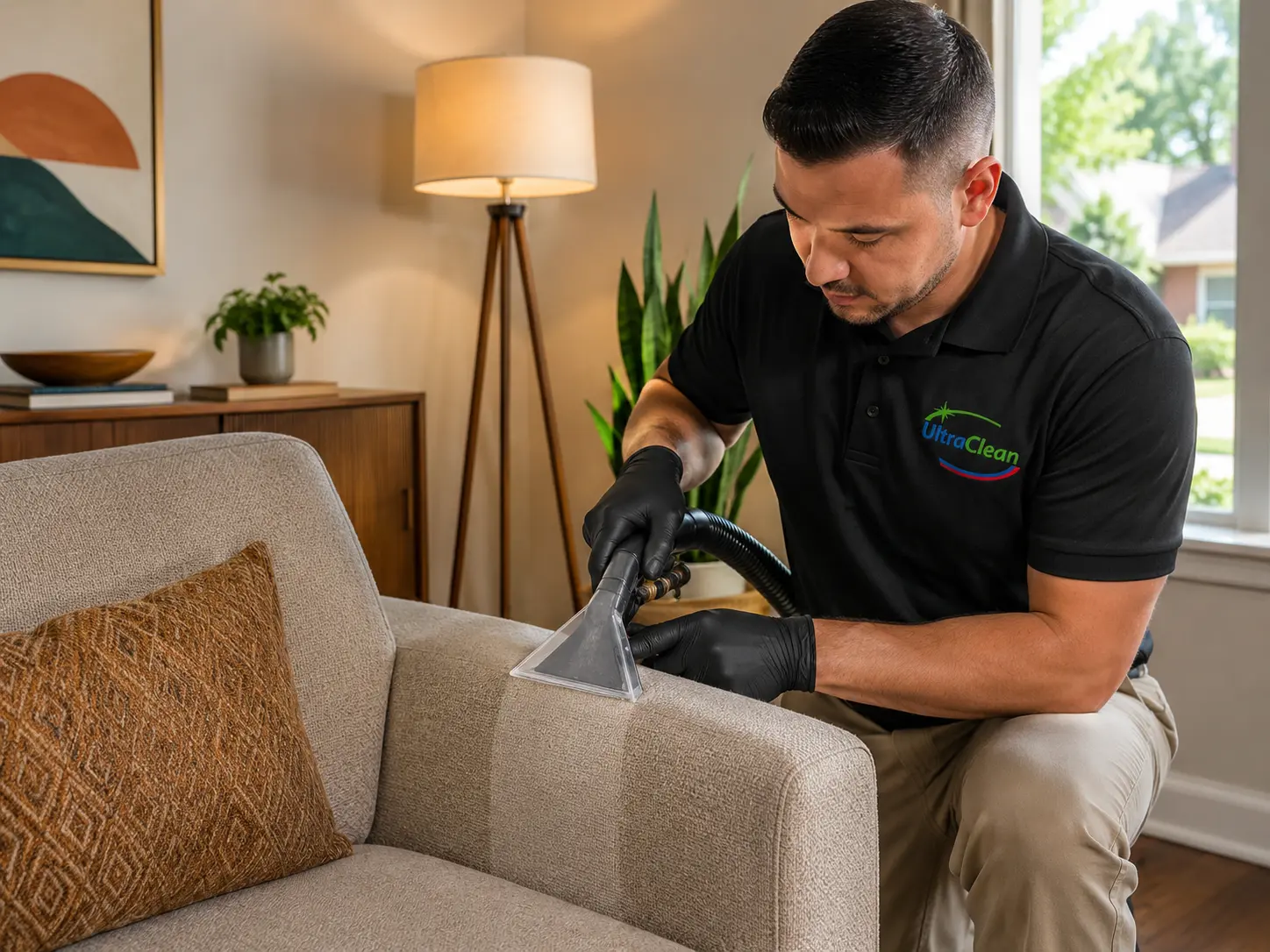
Step 1: Vacuum. A thorough vacuum with appropriate attachments removes loose surface soil before any liquid or solvent touches the fabric. Skipping this step is the most common reason DIY upholstery cleaning underperforms.
Step 2: Fabric identification. We confirm the care code, fiber type, and any pre-existing issues (sun fade, prior repairs, color migration risk). On unidentified fabrics, we test a small inconspicuous area first.
Step 3: Pre-spotting. Stains and high-soil areas get targeted pre-treatment before the main cleaning pass. Chemistry varies by fabric and stain type.
Step 4: Cleaning method appropriate to fabric. Water-safe fabrics get hot-water extraction at low moisture and controlled pressure — much less aggressive than carpet extraction. Solvent-only fabrics get dry solvent applied and recovered with appropriate equipment. WS fabrics get whichever method best matches the soil type.
Step 5: Grooming and drying. The pile or weave is brushed back into uniform direction and air movers are used when needed to accelerate drying.
A typical sofa takes 60–90 minutes. A sectional takes longer depending on size. Drying time is usually 2–4 hours under normal conditions — much faster than carpet because there’s far less water used.
Curious whether your sofa actually needs cleaning?
We’re across Richardson every week — Canyon Creek, Heights Park, Cottonwood Heights, Sherrill Park, and the UTD-area rental corridor. Estimates are free and written, and we use a day-of test patch so you can see the actual difference before committing.
Call (469) 535-9331 or visit ultracleanfloorcare.com/richardson.
How Often, by Use
Honest ranges from our work across Richardson.
Everyday-use family room sofa: every 12–24 months. Most homeowners can stretch to 18 months without visible decline. Annual is closer to optimal for light fabrics.
Sofa in a household with pets: every 6–12 months. Dander and oils accumulate fast. Light-colored fabrics show it sooner.
Sofa in a household with young kids: every 9–12 months. Food spills, juice, snacks, and general wear. Spot-treating between full cleanings extends the interval.
Formal living-room furniture (low use): every 24–36 months. Lightly used pieces don’t need frequent cleaning, but periodic dust removal and fiber refresh matter long-term.
Office reception or commercial seating: every 3–6 months. Public-use furniture sees heavy soil and benefits from frequent maintenance. The Telecom Corridor has a number of office complexes where we handle reception and conference-room upholstery on quarterly schedules.
UTD-area rentals and student housing: between every tenant. Property managers in the corridor around UT Dallas bundle several furnished-rental upholstery jobs into a single trip during summer turnover season.
Throw pillows and accent cushions: with the sofa. These accumulate skin oils and allergens disproportionately because they contact heads and faces.
Dining room chairs (fabric): every 12–18 months. Food contact and frequent use put these closer to the family room frequency than the formal living room.
Specific Fabric Types
Different upholstery materials have specific considerations.
Microfiber. Looks easy to clean — and is, with the right method. But standard water cleaning often leaves dark water rings because the dense fiber wicks water unpredictably. We use low-moisture extraction with specific microfiber chemistry that minimizes ring risk.
Leather. Not technically upholstery cleaning in the fabric sense, but commonly bundled. Leather needs different chemistry — a leather-specific cleaner followed by a conditioner to maintain suppleness. Avoid general-purpose upholstery sprays.
Velvet. Often S-rated (solvent only). Water leaves rings and crushes the pile. Solvent cleaning with careful pile grooming is the right approach.
Linen. Beautiful, breathable, prone to shrinkage. Water-safe but requires very low moisture and careful drying to avoid puckering. Often best handled with very light extraction or dry foam.
Performance fabrics (Crypton, Sunbrella, Revolution). Common in newer infill construction and on outdoor furniture brought indoors. Generally W-rated and forgiving. Tolerate aggressive cleaning when needed.
Cotton blends. Vary widely. Always check the care code. Some shrink dramatically; some are bulletproof.
Optional: Fiber Protection Against Stains
After cleaning, we can apply a fiber protection treatment that creates a microscopic barrier against both water-based and oil-based stains — wine, coffee, juice, salad dressing, kid spills, pet accidents. Future spills bead up on the surface instead of soaking into the fibers, which buys you time to blot before anything sets.
The protection is most effective when applied immediately after a deep clean. We recommend it on light-colored fabrics, kid-and-pet-heavy sectionals, and dining chairs where wine or grease are routine risks. It does not change the look or feel of the fabric.
It’s an optional add-on at the time of cleaning. Pricing depends on the size and number of pieces — written into your free estimate alongside the cleaning itself.
Richardson-Specific Considerations
A few observations from years of doing this work in Richardson.
Tech-professional households want efficient maintenance. A big share of our recurring upholstery clients are dual-income professionals along the Telecom Corridor who book everything — carpet, upholstery, tile — on one annual visit. The model works because they don’t have to think about it again until next year.
UTD rental upholstery turns over fast. Furnished apartments and houses around UT Dallas churn between tenants every 9–12 months. The furniture stays; the tenants change. Property managers schedule us as part of the standard turnover, often bundled with carpet for the unit.
Mid-century homes often have inherited or original pieces. In the older neighborhoods — Heights Park, Reservation, Richardson Heights — we sometimes get called on vintage 1960s and 70s upholstery the homeowner inherited or never replaced. Older fabrics need careful identification before any chemistry touches them; some are not appropriate for water at all.
Allergen accumulation in throw pillows. Decorative pillows in primary bedrooms and family rooms collect allergens that contribute to indoor air quality issues. Cleaning them with the sofa is an inexpensive add-on with real value for allergy-sensitive households.
The 4×4 Test Patch Model for Upholstery
When fabric type, condition, or stain history creates uncertainty, we run a small test area before the full job. Three possible outcomes:
- Clean — the result meets expectations, full job proceeds at the quoted price.
- Alternative service — a different cleaning method or a more focused treatment fits better, with an adjusted quote.
- Stop, no charge — if no approach delivers what you need, we pack up and you owe us nothing.
This is the same model we use for carpet and pet odor work. It eliminates the risk of paying for service that doesn’t work on your specific fabric.
Drying and What to Expect After Cleaning
A note on what’s normal post-service.
Drying time: 2–4 hours for hot-water extraction on most fabrics. Faster than carpet because much less water is used. Solvent cleaning dries even faster — often 30–60 minutes.
Fabric stiffness: Slight stiffness is normal during drying as fibers are still damp. It resolves as the fabric dries completely.
Slight smell of cleaning solution: Fades within a few hours. If a stronger smell persists, ventilation accelerates the process.
Soil “wicking” to the surface during drying: Sometimes deep contamination not fully recovered in extraction migrates back to the surface as the fabric dries. We address this by either over-drying the area with air movers or returning for a follow-up pass.
Visible improvement: Usually dramatic immediately, but the full result appears once the fabric is fully dry and groomed. Don’t judge the final look while it’s still drying.
When to Schedule Around Carpet Cleaning
Many of our Richardson clients book carpet cleaning and upholstery cleaning together. The logic is simple: the truck is at your home, the equipment is set up, and many crews offer pricing efficiencies on combined visits.
The other reason: cleaning carpet without also cleaning the upholstery means the dirty sofa recontaminates the area around it within weeks. Body oils transfer to floors and skin contact transfers them onto the sofa, which then sheds particles onto the freshly cleaned carpet.
If you’re already booking carpet, ask about the upholstery at the same time.
FAQ
How often should I get my upholstery professionally cleaned in Richardson?
Every 12–24 months for everyday-use sofas. Every 6–12 months with pets. Every 3–6 months for commercial use. Schedule sooner if you can see visible soil or notice odor accumulation.
How long does upholstery cleaning take to dry?
2–4 hours for water-based methods on most fabrics. Solvent cleaning dries in 30–60 minutes. Drying is much faster than carpet because much less moisture is used.
How much does upholstery cleaning cost in Richardson?
Pricing depends on size and condition — written estimates are free, no obligation. Call (469) 535-9331.
Can you clean leather furniture?
Yes. Leather requires different chemistry than fabric — a leather-specific cleaner followed by a conditioner. Avoid general upholstery sprays on leather; they can dry out or damage the surface.
What if my sofa doesn’t have a care code tag?
We identify the fiber type at the estimate and run a small test in an inconspicuous area before treating the whole piece. Unidentified fabrics get tested first to confirm the right method.
Will cleaning damage my microfiber sofa?
No, with the right method. Standard wet cleaning often leaves water rings on microfiber — and Richardson’s hard water makes the risk worse with tap-water DIY attempts. We use low-moisture extraction with microfiber-appropriate chemistry. Done correctly, microfiber cleans up beautifully.
Can you remove old stains from upholstery?
Often yes, depending on what caused them and how long they’ve been there. Our day-of test patch shows the actual result before you commit, and if cleaning won’t deliver what you need, we don’t charge.
Related services: If you also need upholstery cleaning in McKinney or pet stain and odor removal in Richardson, we run those routes the same week.
Ready to Refresh Your Upholstery?
Sofas and chairs that look — and feel — clean again.
Call (469) 535-9331 or visit ultracleanfloorcare.com/richardson for a free written estimate.
More for Richardson homes: all our floor, tile & air-duct services in Richardson · air duct cleaning in Richardson
Professional upholstery cleaning follows the fabric-care standards set by the IICRC.