A Trinity Falls homeowner called us last fall convinced her HVAC system was making her family sick. Two of her three kids had developed respiratory issues since they’d moved into the new build eighteen months earlier. Her pediatrician had asked about indoor air quality.
When we opened her plenum, we found drywall dust, fiberglass insulation fragments, and shavings of wood: construction debris from the original build that had never been cleaned out before the system was first fired up. This is one of the most common findings we run into across McKinney, especially in the master-planned communities that have grown rapidly over the past decade.
McKinney’s mix of historic downtown homes with original ductwork and new-construction master-planned builds creates two very different duct situations. Knowing which one you have shapes the right cleaning schedule.
Key Takeaways
- McKinney new builds regularly carry construction debris in the ducts from day one.
- NADCA guidance is inspection every 3 to 5 years — conditions inside the ducts set the real schedule.
- A NADCA-compliant cleaning is a source-removal job with professional equipment, not a shop-vac visit.
- Ultra-cheap whole-house offers are the classic bait — the price changes once they are in the house.
The Honest Industry Answer
There’s a lot of confusion around duct cleaning frequency, mostly because the industry has a noisy fringe of operators running $99-special ads that imply every home needs annual cleaning. That’s not true, and pretending otherwise hurts the customers who genuinely benefit from the service.
NADCA (the National Air Duct Cleaners Association) recommends that homeowners have their HVAC system inspected every three to five years. Cleaning is recommended when an inspection reveals visible mold growth, vermin infestation, significant dust and debris accumulation that’s being released into the living space, or similar contamination.
The EPA takes a similarly cautious position: there’s no proven health benefit to cleaning ducts that are visibly clean, but cleaning is appropriate when conditions warrant it.
In plain English: if your ducts are clean, you don’t need cleaning. If they’re not, you do. The right answer depends entirely on what’s putting debris into the ducts in your specific home.
McKinney-Specific Factors That Shorten the Window
Several factors common to homes in Collin County tilt the answer toward more frequent cleaning than the national average.
Heavy spring pollen. DFW has one of the heaviest pollen loads in the country, with oak, cedar, and mountain cedar peaks that drive air quality alerts for weeks at a time. Pollen that enters through doors and windows gets pulled into the return system and accumulates inside the ducts and on the blower wheel.
Long AC season. Air conditioners in McKinney run roughly six months of the year, usually April through October, sometimes longer. That’s twice the AC runtime of homes in the northern half of the country, which means twice the air volume cycling through the duct system annually.
Construction debris in new builds. Homes built post-2018 in Trinity Falls, Craig Ranch, the newer Stonebridge Ranch sections, and the developments along the western expansion were often handed over with construction debris still inside the ducts. Builders rarely clean ducts before turning on the HVAC at the punch-out walkthrough. Whatever was in there when the drywall went up is still in there.
Original ductwork in older homes. The Victorian-era homes downtown often have HVAC retrofits with ductwork that’s been in place for decades, sometimes with original metal trunk lines from the first central-air installation. These systems benefit from periodic inspection more than calendar-based cleaning.
Bigger lots, more outdoor lifestyle. McKinney’s 1/4-acre and larger lots mean more time spent outside, more doors opened, and more outdoor air pulled in. Pollen, dust, and pet contributions to the return system add up faster than in tightly packed urban neighborhoods.
Humidification add-ons in hard-water areas. Many McKinney homes run whole-house humidifiers in winter to fight dry indoor air. Those units use the same tap water as the rest of the home, which measures 13 to 15 grains per gallon. Mineral scale from hard water can build up on humidifier pads and surrounding ductwork over time, and it shows up during a thorough duct inspection.
Signs Your Ducts Actually Need Cleaning
Forget the calendar. Look for these instead.
Visible dust on supply registers. If you wipe a supply register weekly and it’s coated with dust by the next week, the ducts upstream are pushing dust into the room.
Allergy symptoms that get worse indoors. When indoor air quality is worse than outdoor, something inside the home is the source. Ducts are one common culprit, especially if symptoms improve when you leave town.
Recent construction or renovation in the home. Drywall dust, sawdust, joint compound powder, paint overspray, all of it ends up in the return system.
Visible mold growth around vents or inside the air handler. This is a non-negotiable cleaning indication.
A new pet. Hair and dander accumulate inside return ducts quickly. A year after getting a dog or cat, the system often warrants cleaning.
A musty smell when the AC kicks on. Often points to biological growth on the evaporator coil or in the plenum.
Visible debris falling from supply registers when the system starts up. Diagnostic at the most basic level. There’s stuff in the ducts that doesn’t belong there.
If none of these are present, you probably don’t need cleaning. If two or three are, you almost certainly do.
What a Thorough NADCA-Compliant Cleaning Includes
This is where the industry splits into real cleaning and vacuum-the-register-and-leave. Here’s what a thorough job actually involves.
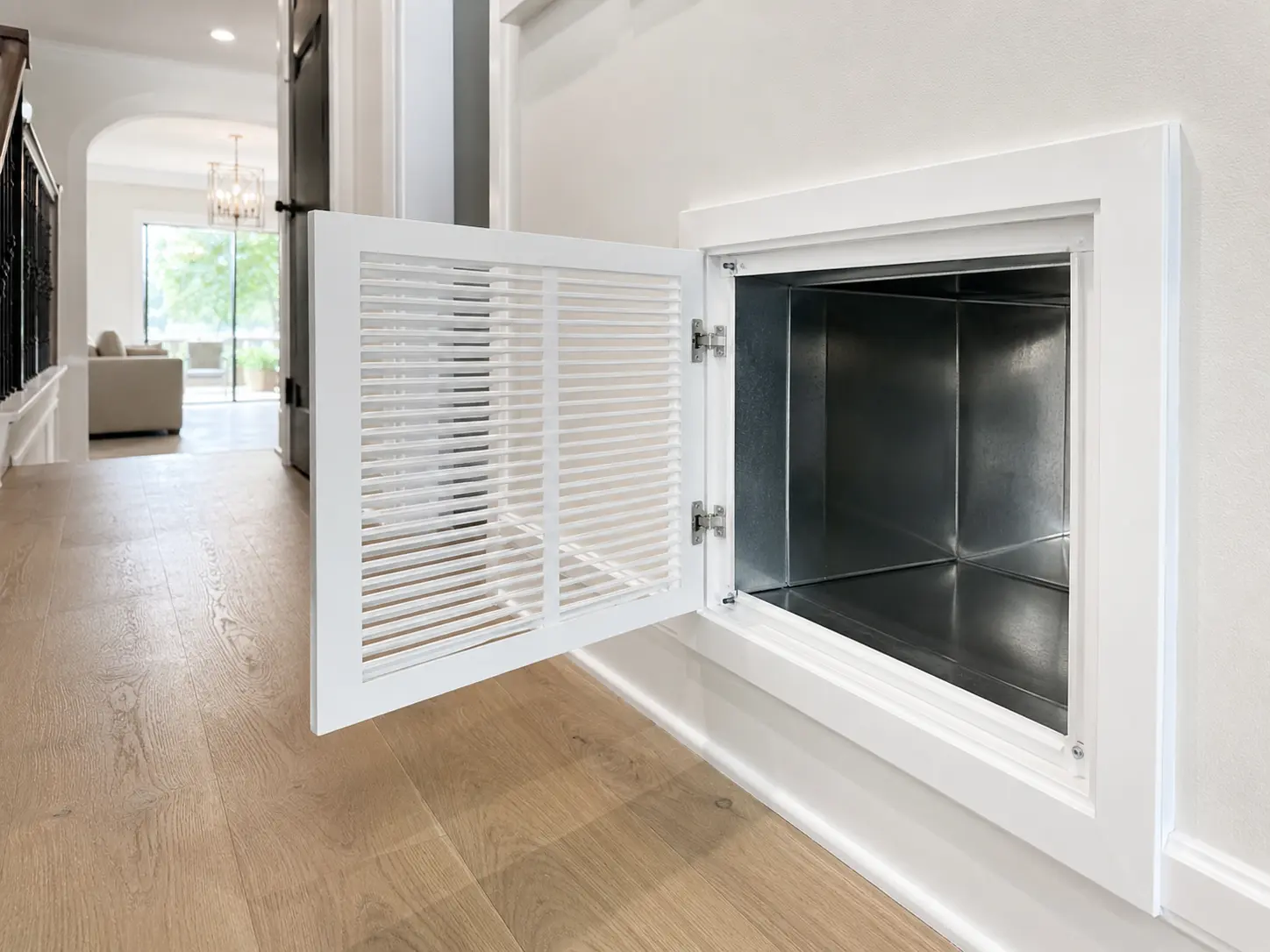
System inspection. We open access panels and inspect supply ducts, return ducts, the plenum, the blower wheel, and the evaporator coil. We document findings with photos.
Negative-air containment. A high-CFM negative-air machine with HEPA filtration creates negative pressure throughout the entire duct system, ensuring that anything dislodged during cleaning gets vacuumed out rather than blown into your living space.
Agitation through every run. Each individual supply and return run is mechanically agitated using brushes or air whips on a flexible rod. The agitation dislodges debris stuck to duct walls, which then gets pulled out by the negative-air machine.
Plenum, blower wheel, and evaporator coil cleaning. The plenum is the central hub. If it’s dirty, it recontaminates everything downstream. The blower wheel collects a thick film of dust over years; cleaning it improves airflow and efficiency.
Final inspection and documentation. We re-inspect the same access points photographed at the start, showing before-and-after results.
A thorough cleaning on a single-system McKinney home typically takes three to five hours. A two-system home takes most of a day. Anything faster than that should be questioned.
Our Equipment: The Rotobrush Beast Lineup
The tool matters as much as the technician. Ultra Clean uses the original Rotobrush Beast for most McKinney residential work, with other Rotobrush Beast configurations on the truck for two-system homes, commercial buildings, and unusually long duct runs. Manufacturer specs are on the Rotobrush Beast manufacturer page.
What makes the Rotobrush Beast the right tool for McKinney residential:
- 450 RPM rotating brush mechanically agitates lint, dust, pet dander, and construction debris off the duct walls instead of relying on suction alone.
- Four vacuum motors with up to 90 percent more vacuum power than older Rotobrush aiR+ systems. Debris gets pulled into the collection bag the instant it loosens.
- 52 ft of hose reach. Enough to clean both supply and return runs from a single access point in most McKinney homes.
- Brushes from 4 inches to 28 inches. The same machine cleans 6-inch flex runs and 16-inch metal trunk lines without swapping equipment.
- Safe for flex ducts. The rotating cable is enclosed within the hose, so plastic flex liners don’t get torn or punctured.
- Removable pod design. One technician can carry the cleaning unit into a McKinney attic without help, which keeps service times short and predictable on the larger homes typical here.
The combination of mechanical brushing plus high-volume vacuum recovery on the same head is what NADCA describes as the gold-standard cleaning method. It’s not the same as the shop-vac-only approach behind the $99 advertised specials.
The $99 Duct Cleaning Scam (And How to Spot It)
You’ve seen the ads. Whole-home duct cleaning, $99. Almost without exception, these are bait-and-switch operations.
The crew shows up with a shop-vac and a brush. They run the brush a few feet into a couple of registers, declare the job done, and then “find” issues: heavy mold contamination, animal infestation, blower-wheel problems that need extra work. The $99 turns into $800, $1,500, or $3,000.
Real NADCA-compliant cleaning cannot be done for $99 anywhere in the country. The equipment alone, a negative-air machine with HEPA filtration, costs more than that to operate for a day. The labor required to agitate every individual run, clean the plenum, blower wheel, and coil takes hours.
National industry pricing for legitimate residential air duct cleaning generally runs around $400 to $1,000 depending on system size, number of runs, and condition. Ultra Clean pricing depends on the specifics. Written estimates are free.
Red flags to walk away from: unusually low advertised prices, claims that cleaning can be done in under an hour, pressure to add antimicrobial fogging without identifying actual contamination, and no before-and-after photos offered.
How Often, by McKinney Home Type
Rough guidance based on patterns we see across McKinney.
New construction (less than 2 years old): Inspect once to determine whether construction debris is in the system. If it is, clean once. After that, follow the normal schedule.
Newer master-planned homes (2 to 10 years, post-2015): Every 4 to 6 years assuming no major renovations, no pets, normal occupancy. The newer Trinity Falls, Craig Ranch, and Westridge builds typically fit here.
Established homes (10 to 25 years): Every 3 to 5 years. Older systems often have failed duct seals at the boots that let attic dust in.
Historic downtown homes (25+ years, original or partially original ductwork): Inspect every 2 to 3 years. Original metal ductwork without proper insulation often has interior rust and accumulated debris that benefits from periodic cleaning. Many of these systems have been retrofitted multiple times, and the duct condition varies widely.
Homes with pets: Reduce intervals by roughly 30 percent. Dander accumulates fast.
After any renovation: Clean once after the project is complete, regardless of when the last cleaning was done.
Frequently Asked Questions
How often should I really clean my air ducts in McKinney?
NADCA recommends inspection every 3 to 5 years, with cleaning when conditions warrant. In McKinney, factors like spring pollen, long AC seasons, pets, and recent construction in newer master-planned communities typically shorten that window for many homes.
Will duct cleaning lower my energy bills?
Sometimes, modestly. A cleaner blower wheel and cleaner coil improve HVAC efficiency. Savings vary widely. The bigger benefits are air quality and equipment longevity.
How much does air duct cleaning cost in McKinney?
Pricing depends on size and condition. Written estimates are free. As a national reference point, legitimate residential duct cleaning generally runs around $400 to $1,000 depending on home size and system complexity.
Is duct cleaning worth it after moving into a new build?
Often yes. Builders rarely clean construction debris from ductwork before the HVAC system is turned on. Drywall dust, insulation fragments, and sawdust can sit inside the ducts for years. An inspection during your first six months in a new home is a good investment, especially in the newer master-planned communities where the home is brand-new.
Can duct cleaning help with allergies?
It can if the ducts are part of the problem. If your home’s allergy symptoms improve when you leave and worsen when you return, indoor air sources, including ductwork, are likely contributing. Cleaning helps when there’s actual debris to remove.
Related services: If you also need air duct cleaning in Plano or dryer vent cleaning in McKinney, we run those routes the same week.
Ready to See What’s Actually in Your Ducts?
We’re across McKinney every week, from Trinity Falls and Craig Ranch to Stonebridge Ranch, Adriatica, Eldorado, Westridge, and the historic downtown homes. We offer honest inspections that include telling you “no, you don’t need this service yet” when that’s the right answer. Estimates are free and written, and we show you photos of what’s inside your system before you decide.
Call (469) 535-9331 or visit ultracleanfloorcare.com/ for a free written estimate.