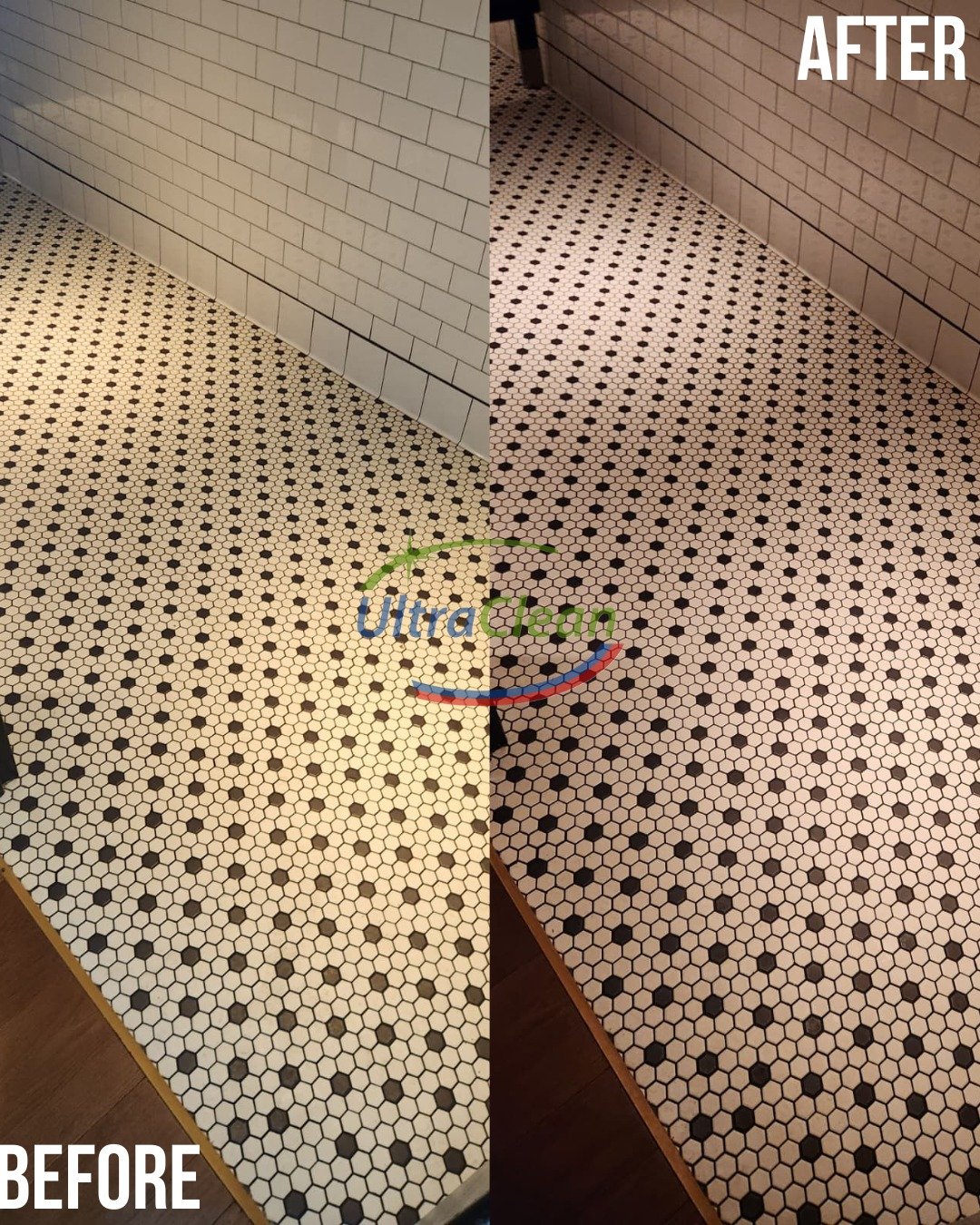
Short answer: Tile looks hazy right after you mop because the mop leaves something behind. The usual culprit is cleaner residue: surfactants from too much floor soap dry into a thin, dull film. In North Texas that film picks up a second layer of hard-water minerals every time the mop water evaporates. More soap makes it worse, and a steam mop just melts the film around. Removing it takes an alkaline pre-treatment that dissolves the residue and a hot-water rinse that carries it off the floor instead of spreading it. If the haze is old wax, sealer or installation grout haze, the floor needs a strip-and-clean first.
We hear it every week in Dallas–Fort Worth: “I just mopped, and the floor looks worse.” Nothing is wrong with your tile. What you’re seeing is a layer on top of it. Here’s where that layer comes from, why it keeps coming back, and what actually takes it off.
Where the haze actually comes from
A glazed ceramic or porcelain tile is close to non-porous, and when it’s truly clean it reflects light evenly. Haze is anything left on the surface that scatters that light. On most DFW floors it’s one of four things, and often two or three stacked together:
- Cleaner residue. Floor soaps and “no-rinse” cleaners contain surfactants. Used at the right dilution, most of them leave with the water. Used strong, or never rinsed, they dry into a sticky, cloudy film.
- Hard-water minerals. Tap water carries dissolved calcium and magnesium. When a wet floor air-dries, the water leaves and the minerals stay as a faint white bloom.
- Re-deposited soil. After the first room, mop water is dirty water. Every pass after that spreads a thin coat of suspended soil back across the tile.
- Old coatings or installation haze. Acrylic floor wax and topical sealers dull and yellow as they wear. On newer floors, a cloudy film can be cement-based grout haze the installers never fully washed off.
Key takeaways
- Haze is a film on the tile, not damage to the tile. Glazed ceramic and porcelain almost always clean back to their original look.
- Too much soap is the most common cause, and adding more cleaner makes it thicker.
- DFW’s hard water adds a mineral layer every time the floor air-dries.
- Film-type haze needs an alkaline pre-treatment plus a real rinse. Wax, sealer and grout haze need a strip first.
- Vinegar will etch marble, travertine and limestone, and over time it wears down cement-based grout.
The chemistry: why more cleaner means more haze
Surfactants work by surrounding oily soil so water can carry it away. That only works if the water actually leaves the floor. A damp mop at the wrong dilution puts down more surfactant than the water can lift. The water evaporates, and the surfactant stays behind as a film that’s slightly tacky to the touch.
A tacky film grabs the next round of dust and foot traffic, so the floor gets dull faster and looks like it needs another mopping. So you mop again, with more soap. Each cycle adds a layer. That’s why a floor can look worse after months of careful weekly cleaning than it did when you moved in.
Why the haze reappears a day after you mop
If the floor looks decent while it’s wet and cloudy once it dries, the film is still there and you’re seeing the minerals. Water flatters a dull surface by filling the micro-texture. As it evaporates, the dissolved calcium and magnesium in it crystallize on top of the residue already down.
Textured and matte tile shows this more than polished tile, because the film settles into the texture and grout lines where a mop can’t lift it. That’s also why grout often looks darker right next to a hazy tile face: the same residue collects soil in the porous grout.
What doesn’t work (and why)
- More floor soap. It adds to the exact film you’re trying to remove.
- Vinegar on everything. Diluted vinegar can cut mineral bloom on glazed ceramic and porcelain. But it’s an acid: it permanently etches calcium-based stone like marble, travertine and limestone, and repeated use erodes cement-based grout.
- Steam mops over an existing film. Heat softens the residue, the pad spreads it thinner, and it dries back into haze. Steam is fine for maintenance on a clean floor, but it won’t strip a film.
- “Shine” or restorer products. Many are polymer coatings. They look glossy for a few weeks, then wear unevenly in traffic lanes and add one more layer to strip later.
How professionals actually remove it
Professional tile cleaning services treat haze as a residue problem, not a scrubbing problem:
- Identify the surface and the film. Glazed ceramic, porcelain and natural stone need different chemistry, and wax or sealer behaves differently from soap film.
- Pre-treat. An alkaline solution dwells on the floor to break down surfactant residue, grease and soil. On stone, the process switches to stone-safe products.
- Agitate. Grout lines are hand-brushed and open areas machine-scrubbed, so the film releases from the tile texture too.
- Hot rinse and extract. Truck-mounted high-temperature pressurized extraction flushes the loosened residue and pulls the dirty water off the floor in the same pass. Nothing is left to dry back into a film.
- Strip first when needed. Old wax, worn topical sealer or installation grout haze won’t release with a standard clean. At Ultra Clean that’s a Restoration Clean strip-and-clean ($1.25 per sq ft) done before the regular cleaning.
- Seal the grout (optional). A penetrating grout sealer keeps mop water and soil out of the grout for 1–3 years, so routine mopping stops re-dirtying it.
Why DFW makes this a bigger deal
By the USGS scale, water between 61 and 120 mg/L of hardness is “moderately hard” and 121–180 mg/L is “hard.” Many DFW suppliers fall right in that range. Garland, for example, reports about 161 mg/L, and Carrollton reports roughly 136–146 ppm. Every air-dried mopping leaves some of those minerals on the floor.
Add the region’s long dusty summers and heavy use of large-format porcelain in newer homes, where one broad hazy tile is easy to spot, and the result is a very common DFW complaint. It’s also one of the easiest to fix properly.
Frequently asked questions
Why does my tile floor look hazy after I mop it?
Usually cleaner residue: floor soap used too strong, or never rinsed, dries into a dull film. Hard-water minerals left as the floor air-dries and soil re-deposited from dirty mop water add to it. The tile itself is almost never damaged.
Does vinegar remove haze from tile?
On glazed ceramic and porcelain, diluted vinegar can cut hard-water mineral bloom. It won’t remove soap film well, and it should never be used on marble, travertine or limestone, which it etches. Repeated use also erodes cement-based grout.
Is tile haze permanent?
Film-type haze from soap, minerals or soil is not permanent. It comes off with an alkaline pre-treatment and a hot-water rinse. Dullness on natural stone can be etching, which is surface damage and needs honing, not cleaning.
How do I keep tile from getting hazy again?
Use a pH-neutral cleaner at the label dilution, not more. Change the mop water often, rinse with clean water, and dry high-traffic areas with a microfiber pad instead of letting them air-dry. Sealing the grout keeps the lines from holding soil.
What does it cost to professionally remove haze from tile in DFW?
At Ultra Clean, standard tile and grout cleaning starts at a $150 service minimum, and a 101–300 sq ft kitchen runs $150–$180 depending on the package. If the haze is old wax, topical sealer or installation grout haze, a Restoration Clean strip runs $1.25 per sq ft first. Every price is quoted upfront.
If your tile looks cloudy no matter how carefully you mop, the problem is the film on top, not your effort. Our tile and grout cleaning strips the residue and rinses it off the floor across Dallas–Fort Worth. Get a free estimate, or call and we’ll tell you honestly whether your floor needs a standard clean or a strip first.