Allen started as a railroad water stop and is now mostly 21st-century homes. In 1874 Irish immigrant crews working for the Houston and Texas Central Railway built a 69-foot limestone dam on Cottonwood Creek to fill the steam engines’ water tower. That dam still stands in the Allen Water Station, which joined the National Register of Historic Places in 2009. But most of the city grew up far more recently: Allen had 43,554 residents in 2000, 84,246 in 2010 and 104,627 in 2020. For most homeowners that means tile and grout between 5 and 25 years old, laid during one of the fastest building runs in Collin County.
The short answer: most Allen homes should have tile and grout professionally cleaned every 12 to 18 months. Because Allen’s water can run hard, showers and tub surrounds usually need attention sooner than floors, and grout sealing after each cleaning is the best way to slow new staining and scale.
Key Takeaways
- Allen buys treated water from the North Texas Municipal Water District, and Lavon Lake is the district’s main source.
- The City of Allen’s water quality report lists hardness from 82 to 312 ppm, which covers moderately hard to extremely hard water.
- Population roughly doubled from 2000 to 2010 and passed 100,000 by 2020, so most Allen tile went in during the last 25 years.
- The older core near Allen Station Park and the historic depot area has older buildings than the surrounding subdivisions.
- Busy mixed-use spots like Watters Creek (opened 2008) put restaurant and retail tile under constant traffic.
Lavon Lake Water and a Wide Hardness Range
Allen’s tap water comes from the North Texas Municipal Water District, whose main supply is Lavon Lake. Mineral content changes with the season and the blend, and the city’s own water quality reporting shows hardness from about 82 ppm at the low end to 312 ppm at the high end. At the high end, calcium and magnesium leave a chalky film on shower walls, glass and grout joints within weeks. Unsealed cement grout absorbs that film along with soap residue. The joints go gray, then darker, and scrubbing at home stops helping. A professional clean that dissolves mineral scale, followed by a penetrating sealer, handles both the discoloration and the reason it keeps coming back.
Twenty Years of Fast Building: What That Means for Your Grout
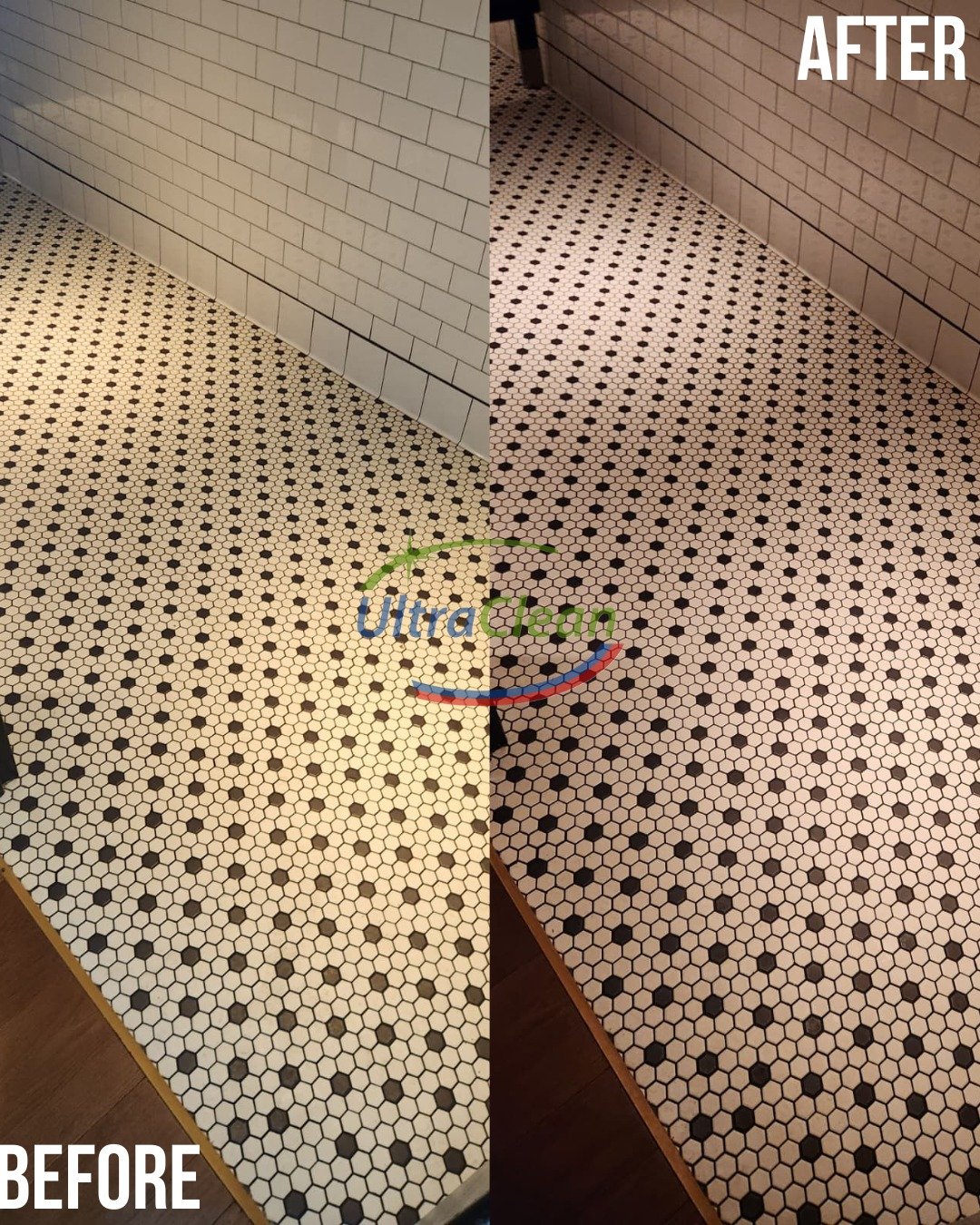
When a city adds about 40,000 residents in a single decade, tile goes in quickly. Many Allen kitchens, entries and bathrooms from the 2000s and 2010s have ceramic or porcelain set with sanded cement grout that got a light seal or none when it was installed. Fifteen years later, the grout lines where people cook and walk are usually the darkest thing on the floor. The tile itself is often fine. The grout is porous and has been soaking up spills and tracked-in North Texas clay the whole time. Hot-water extraction with hand-brushed grout lines usually brings back the original color without regrouting.
From the Depot District to Watters Creek
Allen’s older buildings sit near Allen Station Park and the historic depot area. The Texas Electric Railway interurban stopped here starting in 1908, on its line from Dallas to Sherman. Older floors in this part of town tend to be more porous and sit over older subfloors, so a lower-pressure, pH-neutral process protects them better than the aggressive approach that works on new porcelain. At the other end of the city’s timeline, Watters Creek opened in 2008 as an outdoor mix of patio dining, shops, apartments and offices. Restaurant kitchens and entries there take the kind of steady foot traffic and grease that calls for a quarterly commercial schedule rather than an annual one.
Professional Tile & Grout Cleaning
Truck-mounted hot-water extraction, hard-water scale removal, hand-brushed grout lines, and sealing. Upfront pricing, free estimate.
Frequently Asked Questions
Where does Allen’s water come from?
Allen buys treated water from the North Texas Municipal Water District, and Lavon Lake is the district’s main source. The city’s water quality report lists hardness from 82 to 312 ppm.
Why does my Allen shower grout keep turning white or gray?
Hard water leaves calcium and magnesium on the surface, and unsealed grout absorbs that residue along with soap scum. Removing the mineral scale and then sealing the grout slows the buildup a lot.
How often should Allen homes have tile and grout cleaned?
Every 12 to 18 months is a good baseline. Showers, kitchens and entries often benefit from the shorter end of that range, with sealing after each cleaning.
Do newer Allen homes really need grout sealing?
Usually, yes. Many homes built during the 2000s and 2010s growth period got builder-grade grout with a light seal or none at all, so the joints stain quickly until they are properly sealed.
Ultra Clean is IICRC-certified and has served the Allen and Dallas–Fort Worth area since 2013. Our methods follow the standards set by the IICRC.
More for Allen homes: all our floor, tile & air-duct services in Allen · air duct cleaning in Allen · marble polishing in Allen · tile & grout cleaning across DFW