Quick Answer
Plano hardwood floors fall into two categories: solid oak from 1980s-90s homes and engineered wood in newer master-planned builds. Solid wood survives humidity swings better but shows wear faster. Engineered wood cleans more easily but cannot be sanded repeatedly. Both need pH-neutral cleaning, controlled humidity (35-55 percent), and a professional deep clean every 12-18 months. Ultra Clean does revitalizing cleaning, wax stripping, and Revitalization (urethane top-coat over existing polyurethane). We do not sand-and-refinish or screen-and-recoat.
By Ultra Clean IICRC-certified, Family-owned, Serving Plano since 2013
The Two Plano Hardwood Archetypes
Walk into a 1986 home off Coit Road and you will likely find 3/4 inch solid red oak running through foyer and dining room. Walk into a 2022 build in Legacy West and you will see 7-inch wide-plank engineered oak across the entire main floor. They behave very differently.
Solid Hardwood (1980s-90s West Plano Homes)
Found in West Plano off Parker Road, Coit Road, Independence and Custer corridors south of Park. Typically 3/4 inch solid red or white oak, 2-1/4 inch strip width, nailed to plywood subfloor over slab.
Strengths: Can be sanded and refinished 4-6 times over lifetime. With proper care, a solid oak floor installed in 1988 can easily last another 50 years.
Vulnerabilities: Installed before modern moisture barriers were standard. Expand and contract more visibly with humidity changes. Pet stains and water damage from past plumbing issues are often baked in.
Engineered Hardwood (Legacy West and New Builds)
Legacy West, newer Willow Bend sections, and developments along the Dallas North Tollway. Real wood veneer (typically 2-4mm) glued to a plywood or HDF core.
Strengths: More dimensionally stable in humidity swings. Tougher factory finish resists scratches and UV fading. Easier to clean because the surface is sealed tighter.
Vulnerabilities: The veneer is the only sandable material. Once it is gone, the floor is done. Most engineered floors can only be refinished once if at all.
DFW Humidity Damage
DFW indoor relative humidity can vary from under 25 percent in January (heater running) to over 60 percent in July and August (AC under-performing). That 35-point swing is the single biggest stressor on wood floors.
Winter (low humidity): Gaps appear between boards. Cracks may develop along the grain.
Summer (high humidity): Boards push against each other and cup – edges raise higher than centers. Severe cases see crowning or buckling at doorways.
Our Three-Path Decision Tree
We do not screen-and-recoat and we do not sand-and-refinish. If your floor genuinely needs to be sanded to bare wood, we will tell you and recommend a refinisher. What we do well is everything that comes before refinishing, which keeps most floors looking great years longer.
Path A: Revitalizing Clean (Every 12-18 Months)
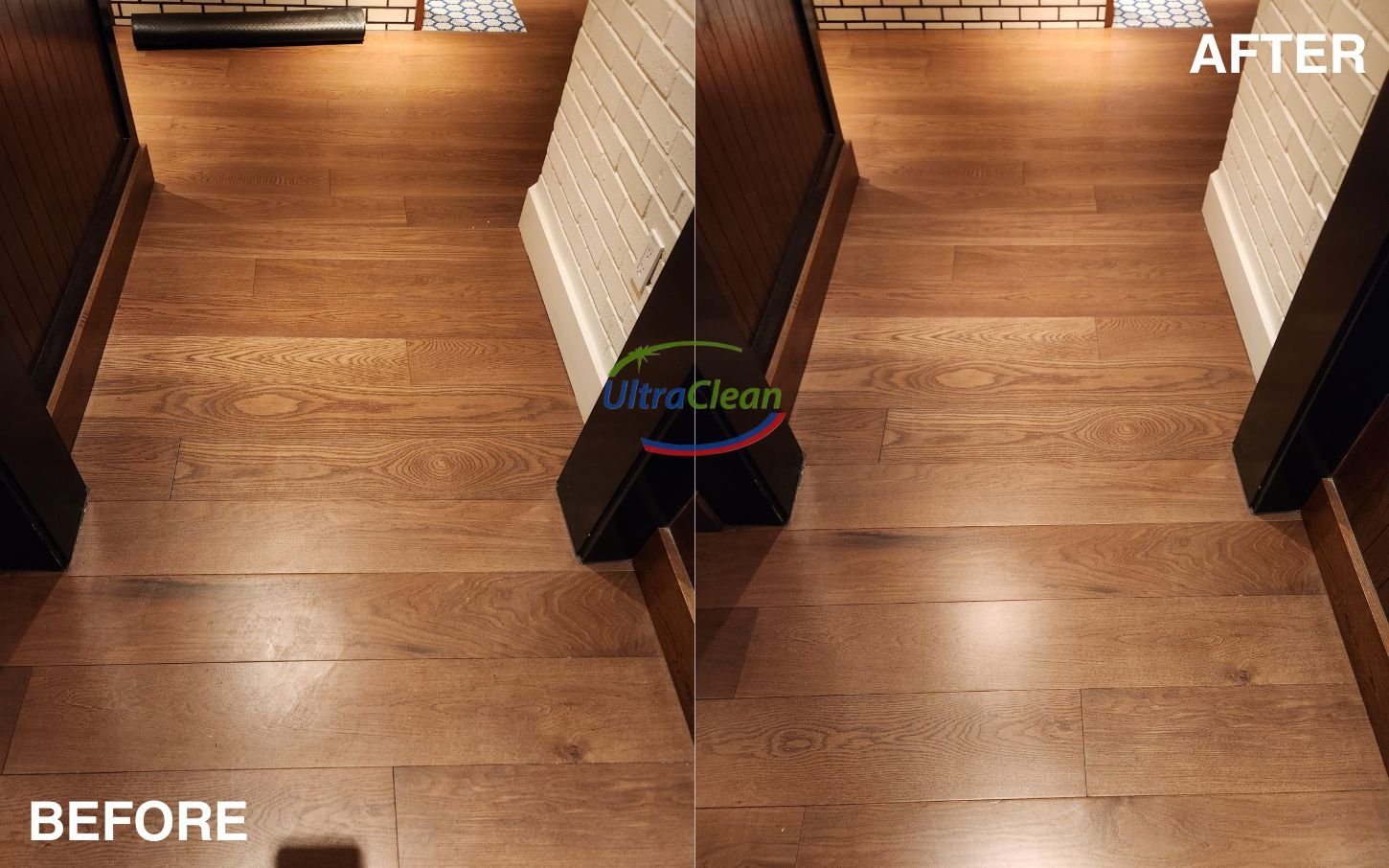
Professional deep clean removes embedded grime and old cleaning residue without touching the finish. Wood-safe solution and low-moisture extraction – no flooding.
On solid hardwood with sound polyurethane: restores 80-90 percent of original look. On engineered with factory finish: closer to 95 percent.
Cost: typically 0.60 to 1.20 dollars per sq ft. Lasts 12-18 months.
Path B: Wax Strip + Natural Polish
If your floor has years of acrylic polish or wax buildup (Murphy Oil Soap, Bona Refresher, supermarket products), cleaning alone will not cut through it. Buildup gets stripped off first. Then the wood gets natural polish with a soft polishing pad – no chemicals on top, just a controlled mechanical polish that brings sheen back.
Cost (wax strip): typically 0.95 to 1.50 dollars per sq ft.
Path C: Revitalization (Urethane Top-Coat)
We call this service Revitalization. When the underlying finish is intact but has lost shine, we apply a urethane coating over the existing polyurethane that gives the floor renewed gloss and adds a fresh protective layer – without sanding, staining, or dust.
This is not a screen-and-recoat (which abrades existing finish first) and not a refinish (which removes existing finish entirely). It is a top-coat that bonds to the cleaned, stripped, prepped existing finish.
Cost (Revitalization): typically 0.75 to 1.25 dollars per sq ft.
What If My Floor Needs Sanding?
We tell you straight at the estimate. We will not sell you a clean-and-polish service that will not deliver. If sanding is the right answer, we point you to a reputable refinisher in DFW. After they finish, you come back to us for 12-18-month maintenance.
Products to Avoid
- Acrylic-based polishes: Leave a film that traps dirt and builds up into a cloudy layer.
- Murphy Oil Soap: Leaves residue that prevents future refinishing products from bonding.
- Steam mops: The single most damaging tool. Steam forces moisture through finish into wood.
FAQ
How often should I deep-clean hardwood floors in Plano?
Every 12-18 months for professional cleaning. With kids, pets, or heavy entertaining, lean toward 12.
Can engineered hardwood be refinished?
Sometimes – even though we do not refinish ourselves. Engineered floors with 3mm+ veneer can be sanded and refinished once, occasionally twice, by a refinishing specialist. Thinner veneer cannot.
What is the cheapest way to make old Plano hardwood look better?
A revitalizing clean, plus wax-and-buildup strip if needed, plus Revitalization (urethane top-coat). Costs a fraction of sanding-and-refinishing and buys 3-7 more years.
Call (469) 535-9331 or visit ultracleanfloorcare.com/plano for a free in-home assessment.
For homeowner guidance on wood-floor care, the National Wood Flooring Association is the industry’s authoritative resource.